

If your company’s filed financial statements did not comply with the Companies Act 1967 or the accounting standards, your directors can revise them and file a notification of revised financial statements with ACRA. You do not need a court order. You do need to move within 30 days of the date of revision.
Raffles Corporate Services works with a panel of experienced Singapore law firms who offer cost-effective and efficient legal service and advice. This article is general information only and is not legal advice.
That last point is where most companies come unstuck. The 30 days does not run from the day you spotted the error. It runs from the date your directors approve the revised accounts, which means the clock only starts once you are already most of the way through the work. Companies that treat the approval date as the finish line rather than the starting gun end up filing late and paying a penalty on top of an embarrassment.
Here is what a revision actually involves, what has to appear in the revised accounts, and where the process goes wrong.
What counts as “defective” financial statements?
Defective means non-compliant, not merely imperfect. Section 202A of the Companies Act 1967 is engaged where it appears to the directors that the financial statements, or in the case of a parent company the consolidated financial statements or balance sheet, do not comply with the requirements of the Act, and compliance with the prescribed accounting standards is part of those requirements.
So the test is legal, not aesthetic. A presentation you would do differently with hindsight is not defective. A misapplied standard, an omitted disclosure the standard requires, a consolidation that should have happened and did not: those are defective.
Section 202A is deliberately narrow in a second way. Under section 202A(3) the revision must be confined to the aspects that did not comply, plus any necessary consequential revisions. You are not reopening the accounts. You are fixing the defect and whatever else the fix necessarily disturbs. Directors who use a revision as an opportunity to restate unrelated judgements are outside the section.
When section 202A becomes available
Section 202A applies only after the accounts have gone out. For a private company that has dispensed with the annual general meeting under section 175A, the trigger is the sending of the financial statements to members under section 203. For every other company, the trigger is the laying of the accounts before the company at an AGM. Before that point there is nothing to revise in the section 202A sense: you simply produce correct accounts.
When you do not use this route
Two situations look like a revision and are not.
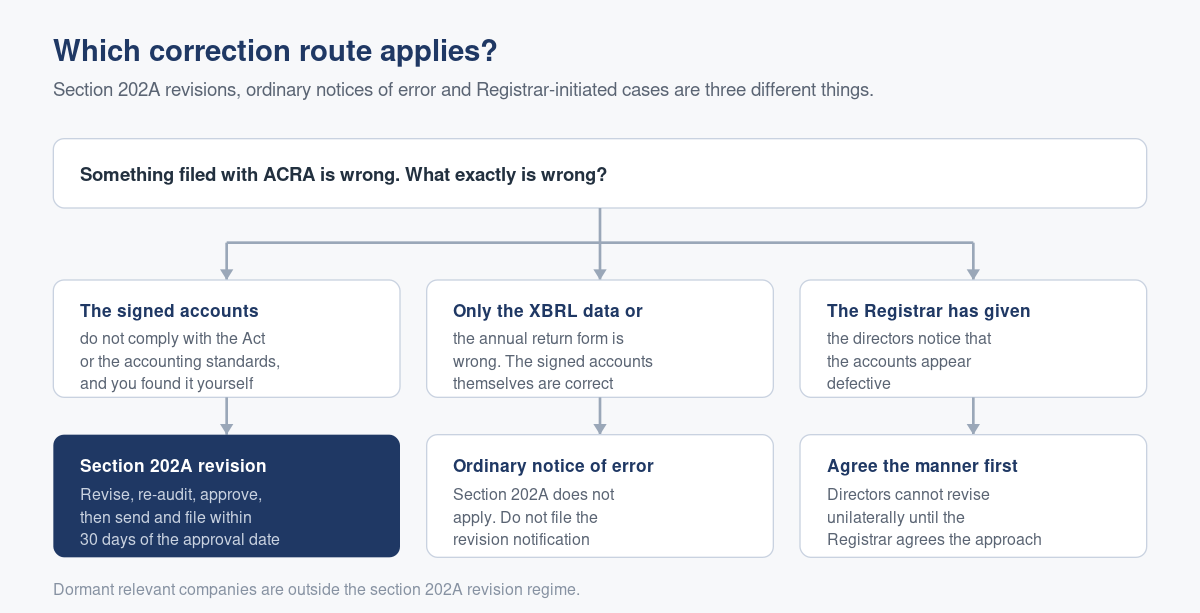
You are correcting the XBRL or the annual return form, not the accounts themselves. If the signed financial statements are correct and the error is in what was keyed into the XBRL data or the annual return, that is an ordinary notice of error, not a section 202A revision. Getting this wrong costs you a filing fee and a month of processing time for no benefit. If XBRL is the source of the problem, our guide to XBRL filing with ACRA sets out how the data and the statements relate, and our note on the annual return under section 197 covers the form itself.
The company is a dormant relevant company. The revision regime does not apply to it.
There is also a separate route running in the opposite direction. Section 202B allows the Registrar to give directors notice that the accounts appear defective, and to apply to the Court if the matter is not resolved. Where the Registrar has given a section 202B(1) notice, the directors cannot simply revise on their own terms: section 202A(4) requires the Registrar to agree the manner of revision first. A revision you initiate is a different animal from one you are pushed into.
What must appear in the revised financial statements
The Companies (Revision of Defective Financial Statements, or Consolidated Financial Statements or Balance-sheet) Regulations 2018, made under section 202A(5) and available on Singapore Statutes Online, are prescriptive about content. Regulation 6 requires the following to be set out in a prominent position in the revised accounts:
- A statement that the revised accounts replace the original accounts for the same financial year.
- A statement that the revised accounts are taken as having been prepared on the date of the original accounts, and accordingly do not deal with events after that date.
- A statement of the aspects in which the original accounts did not, as it appears to the directors, comply with the Act, and of the material revisions made.
- A statement that the directors have approved the revised accounts, and the date of that approval.
The new directors’ statement carries its own list under regulation 6(2), including the approval date, a statement that it replaces the original directors’ statement, and a statement that it has been prepared in accordance with the Regulations.
Two points catch people out. The “do not deal with events after the date of the original accounts” rule means a revision is not a chance to bring the picture up to date: the revised accounts are a corrected photograph of the same moment. And the new directors’ statement must name every person who was a director at any time between the date of the original accounts and the date of revision, with appointment and cessation dates.
The audit position
Where the company has an auditor, regulation 10 requires the auditor to report to the members on the revised accounts. The directors may instead resolve that the accounting entity which reported on the original accounts makes the report, if that firm agrees. A company that revises and has no auditor must appoint an accounting entity to make the report.
This is the step that drives the timetable. The auditor’s report has to reach the directors in time for the 30 day sending deadline, which in practice means the audit work has to be substantially complete before the directors approve the revision, not after.
The 30 day clock, in order
“Date of revision” is defined in the Regulations as the date the directors approve the revised accounts. Both 30 day obligations run from it.
- Prepare the revised accounts and new directors’ statement to the content requirements above, with the amended auditor’s report where applicable.
- The directors approve them. This date goes in the new directors’ statement, and it starts both clocks.
- Send the revised accounts within 30 days of the date of revision to everyone who received the original accounts, and to everyone entitled to receive notice of a general meeting as at the date of revision. Regulation 7 imposes this.
- File with the Registrar within 30 days of the date of revision: the revised accounts, the new directors’ statement, and where applicable the auditor’s report. This is the notification of revised financial statements, lodged as a notice of error through the general lodgement eService in Bizfile.
- Lay the revised accounts at the next general meeting held after the revision.
The Registrar may allow a longer period than 30 days in either case, but you have to ask, and you should not assume.
Fees and turnaround
| Item | Position |
|---|---|
| Filing fee for the notification | $200 |
| ACRA processing time | 30 working days |
| Who may file | A company officer (director or secretary), or a corporate service provider engaged to file |
| What you need before you start | UEN, the transaction number of the filing that contained the error, the revised documents |
| If approved | ACRA tags the notification and the revised accounts to the original annual return; both are visible in Bizfile |
| If rejected | ACRA emails the reasons and the next steps |
Note the asymmetry: 30 days to file, and up to 30 working days before you hear back. A revision undertaken in the run-up to a financing or a sale needs to start earlier than people expect.
What goes wrong, and what it costs
Late filing. Miss the 30 days and a late lodgement penalty applies. Worse, regulation 13(3) makes non-compliance with the filing requirement an offence by the company and by every officer in default, punishable on conviction by a fine not exceeding $2,000. The Regulations attach a similar penalty to the sending and laying obligations. These are not theoretical: they sit on the directors personally.
Assuming an existing relief carries over. If ACRA previously granted your company relief from a form or content requirement for the original accounts, that relief does not automatically extend to the revised accounts or the new directors’ statement. You apply again. Companies that rely on last year’s relief letter are filing non-compliant documents while believing the opposite.
Sending to the wrong list. The obligation runs to everyone who received the original accounts, plus everyone entitled to notice of a general meeting as at the date of revision. Those are two different lists, and the second one has moved if shares have changed hands since. Pull the current register of members rather than reusing the old distribution list.
Treating the revision as a restatement. The confinement rule in section 202A(3) is real. A revision that reaches beyond the defect and its consequences invites rejection and a second round of fees.
Not checking the transaction number. The notification has to be tied to the filing that contained the error. Your Bizfile transaction history will tell you which submission that was, and it is worth checking before you start rather than mid-form.
Frequently asked questions
Do I need a court order to revise my company’s financial statements?
No. Section 202A of the Companies Act 1967 lets directors revise defective financial statements voluntarily, without applying to court. The court route still exists under section 202B, but it is the Registrar’s application, not yours, and it is what section 202A was designed to let companies avoid.
What is the deadline for filing revised financial statements?
Thirty days from the date of revision, which is the date the directors approve the revised accounts. The same 30 days applies to sending the revised accounts to members and others who received the originals. The Registrar may allow longer, but only if you ask.
Can I revise only part of the financial statements?
You must. Section 202A(3) confines the revision to the aspects that did not comply with the Act, plus any necessary consequential revisions. You cannot use a revision to restate unrelated judgements or to bring the accounts up to date for later events.
Does the auditor have to re-report?
Yes, if the company has an auditor. Regulation 10 requires a report to the members on the revised accounts. The directors may resolve that the firm which audited the original accounts does it instead, if that firm agrees. A company with no auditor must appoint an accounting entity for the purpose.
What does it cost to file the notification?
The filing fee is $200, and ACRA takes up to 30 working days to process it. Late filing attracts a late lodgement penalty, and the Regulations also make default an offence by the company and by every officer in default.
We only got the XBRL wrong. Is this the right form?
No. Correcting XBRL data or the annual return form is an ordinary notice of error, not a section 202A revision. Section 202A is for the signed financial statements themselves. Filing the wrong one wastes a fee and a month.
Getting the accounts right the first time
Most revisions trace back to the same root: nobody with the relevant technical knowledge looked at the accounts before they were signed. The error is found later by an auditor, a lender, a buyer or ACRA, and by then the fix costs a filing fee, a re-audit, a board meeting and a month of waiting.
Raffles Corporate Services prepares and reviews financial statements against the Companies Act 1967 and the prescribed accounting standards, and files annual returns and corrections with ACRA. If you already know something is wrong with a set of filed accounts, the sooner the revision is scoped the cheaper it is. If you are not sure whether what you have found is a defect or a preference, that is a short conversation.
For the wider framework, our Companies Act 1967 deep-dive FAQ covers the surrounding obligations, and there is more on Singapore corporate secretarial practice at Singapore Secretary Services.
— The Editorial Team, Raffles Corporate Services
Need help with accounting or bookkeeping?
If you would like accounting, bookkeeping or financial reporting support for your business, email [email protected] or WhatsApp +65 8501 7133.
Our accounting and tax advisers can assist. Where legal advice is needed, advisers from our associated law firms can also assist.