

You have eight days beginning with the date of the special resolution to lodge the publication for a proposed reduction of share capital. It is free, it is processed immediately, and if you miss it the reduction cannot take effect at all. Not late. Not at all.
Raffles Corporate Services works with a panel of experienced Singapore law firms who offer cost-effective and efficient legal service and advice. This article is general information only and is not legal advice.
That is a harsher consequence than most filing deadlines in the Companies Act 1967, and it catches people because the filing sounds like housekeeping. It is not housekeeping. It is the statutory publicity requirement, and the reduction power in sections 78B and 78C is conditional on meeting it.
Here is what the filing is for, what goes into it, the second deadline sitting right next to it that runs on a different clock, and what actually happens when a company gets the timing wrong.
Why this filing exists at all
Reducing share capital takes value out of the buffer that protects creditors. The court-approved route asks a judge to check that creditors are not prejudiced. The solvency statement route replaces the court with two substitutes: the directors’ own solvency statement, and public notice so that creditors can find out and object if they wish.
This filing is the public notice half. Section 78B(1)(c) lets a private company limited by shares reduce its share capital by special resolution only if the company meets such publicity requirements as may be prescribed by the Minister. Section 78C(1)(c) says the same for a public company. The prescribed requirement lives in regulation 6 of the Companies Regulations.
Once the notice is lodged, the Registrar makes it available for inspection by any person. That is the point. A creditor who looks can see that the company proposes to reduce its capital, by how much, and decide whether to apply to court under section 78D(2) to have the resolution cancelled.
What regulation 6 actually requires
Regulation 6(1) is short. The company meets the publicity requirements if it lodges with the Registrar, within eight days beginning with the resolution date, a notice containing:
- the text of the special resolution for reducing share capital;
- the resolution date; and
- the reduction information,
in the format specified by the Registrar, and pays the prescribed fee.
“Reduction information” is not a loose phrase. Section 78A(4) defines it as the amount of the company’s share capital that is thereby reduced, and the number of shares that are thereby cancelled. Two figures. In Bizfile you will also select the nature of the reduction from a list and set out the key points of the resolution, which is how the Registrar’s specified format is implemented in practice.
The newspaper advertisement is optional, whatever you have been told
Regulation 6(2) says the company may, in addition to lodging the notice, publish a notice containing the reduction information in a daily newspaper circulating generally in Singapore.
May. Not must. This is the most common piece of misinformation in the area, and it is expensive misinformation: a company that thinks it needs an advertisement will pay for one, and will sometimes delay the timetable while it books the column inches.
There are legitimate reasons to take the option. With a scattered trade creditor base, a newspaper advertisement is cheap insurance against a later argument about prejudice, and if a buyer’s solicitors will run diligence on the process it is one less question. But it is a commercial decision, not a legal condition, and nothing about the validity of the reduction turns on it.
How long the notice stays visible
Regulation 6(4) sets the shelf life. The lodged information remains available for inspection until one of four things happens: the special resolution is revoked; the court cancels it; the company becomes unable to reduce its share capital through non-compliance with Division 3A of Part 4 of the Act; or one month after the reduction has taken effect.
That last limb matters if you are a creditor rather than a company. The window to see this information is not indefinite, so if you monitor a counterparty’s capital position, a monthly check is not frequent enough.
The eight day clock and the fourteen day clock are different filings
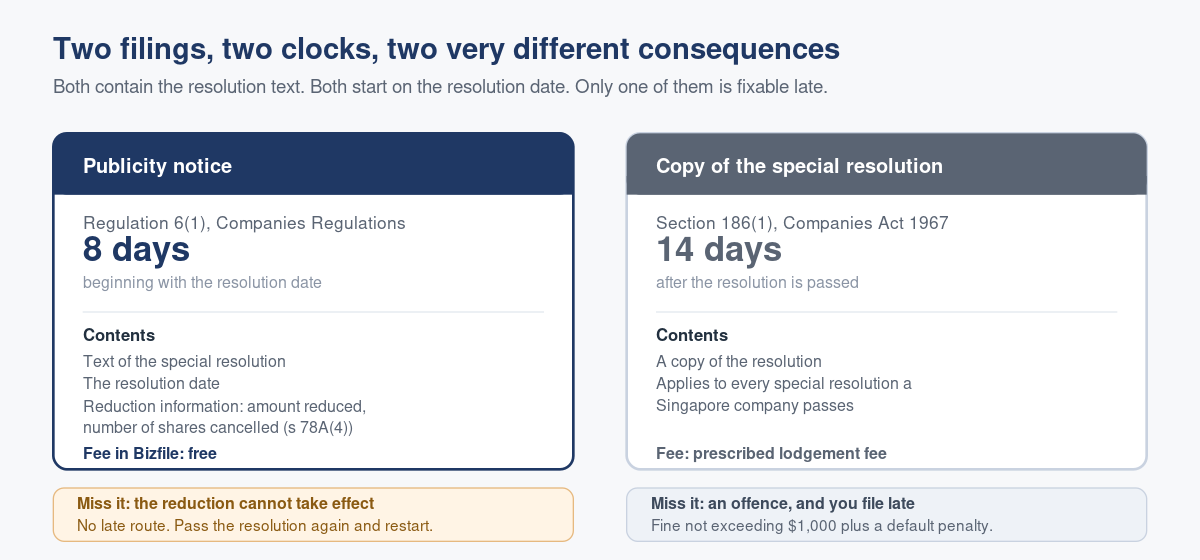
A special resolution has to be lodged with the Registrar within 14 days after it is passed, under section 186(1) of the Companies Act 1967. That is a general obligation applying to every special resolution a Singapore company passes, and default carries a fine not exceeding $1,000 plus a default penalty under section 186(3).
The publicity notice under regulation 6 is a different filing, on a shorter clock, with a different consequence for missing it. Both contain the text of the resolution. Both start from the resolution date. People conflate them constantly, file on day twelve thinking they are inside the window, and discover that the publicity requirement was never met.
| Publicity notice | Copy of special resolution | |
|---|---|---|
| Source | Regulation 6(1), Companies Regulations | Section 186(1), Companies Act 1967 |
| Deadline | Within 8 days beginning with the resolution date | Within 14 days after the resolution is passed |
| Contents | Resolution text, resolution date, reduction information | Copy of the resolution |
| Consequence of missing it | Section 78B(1)(c) or 78C(1)(c) is not satisfied, so the reduction cannot take effect | Offence: fine not exceeding $1,000 plus a default penalty |
| Can it be fixed late? | No. The resolution must be passed again | Yes, by filing late and bearing the penalty |
| Fee in Bizfile | Free | Prescribed lodgement fee |
The asymmetry is the point. One of these is a penalty you can pay. The other is a restart.
The steps, in order
You cannot make this filing until the special resolution has been lodged. Bizfile enforces the sequence and only offers the transactions currently open to you. The resolution filing is covered in our companion piece on filing the special resolution for a share capital reduction under sections 78B and 78C.
- Log in to Bizfile as a business user through Corppass, or have your corporate service provider file from its own profile. Confirm the correct entity is on screen first.
- Open the reduction of share capital eService. The overview page confirms the special resolution has been filed and offers the next step.
- Select the transaction for filing the publication for a proposed reduction of share capital under section 78B or 78C.
- Check the entity details, then enter the key points of the special resolution.
- Select the nature of the reduction. If it does not fit any listed category, choose the other option and describe it.
- Enter the share capital position: number of shares, issued share capital and paid-up share capital, as applicable.
- Save, then review and confirm.
- Tick the declaration and submit. You will get an on-screen acknowledgement and a Bizfile notification.
One operational trap in step 4. The free text fields accept only letters, numbers, full stops, forward slashes and ampersands. Paste resolution wording straight out of a Word document and you will bring smart quotes, dashes, brackets and section symbols with you, and the form will reject the entry without telling you which character caused it. Draft the key points as plain text first.
What happens after you file
Two things start, and only one of them is under your control.
The creditor objection period runs for six weeks beginning with the resolution date, under section 78D(2). Note that it runs from the resolution date, not from the date of this filing. Filing on day eight rather than day one does not extend the creditor window; it just shortens the period during which creditors could actually have seen the notice.
Meanwhile, section 78B(4)(b) requires the company to make the solvency statement, or a copy, available at its registered office for inspection free of charge by any creditor, throughout those six weeks. Section 78B(5) makes clear that failing to do so does not invalidate the resolution, but every officer of the company in default is guilty of an offence.
At the end of the six weeks, if no creditor has applied to court, a window opens for the closing filing under section 78E, and it shuts at the end of week eight. That is the filing that actually makes the reduction take effect, and we deal with it in detail in filing a section 78E share capital reduction.
What goes wrong, and what it costs
Filing on day nine. There is no discretion and no late filing route. The publicity requirement in section 78B(1)(c) or 78C(1)(c) has not been met, the precondition to the reduction power is not satisfied, and section 78E never becomes available. The company must convene again, pass a fresh special resolution, make a fresh solvency statement within the 20 day pre-resolution window that section 78B(3)(b) allows, lodge a fresh publicity notice inside eight days, and wait another six weeks.
Counting from the wrong day. “Within eight days beginning with the resolution date” includes the resolution date itself. A resolution passed on 1 October 2026 must be publicised by 8 October 2026, not 9 October 2026. One day of inclusive counting costs a ten week restart.
Reduction information that does not match the resolution. The notice must state the amount of share capital reduced and the number of shares cancelled. If the resolution authorises a reduction of $400,000 by cancelling 400,000 ordinary shares and the notice says 4,000,000 shares, you have publicised something the members did not approve. Best case is a notice of error filing. Worst case is that the proposal on public view and the proposal actually approved are different proposals, which is precisely the defect a creditor would rely on.
Treating every reduction as a share cancellation. Extinguishing or reducing unpaid liability on shares under section 78A(1)(a) leaves the share count untouched. Returning surplus paid-up capital under section 78A(1)(c) may or may not cancel shares, depending on structure. Settle the structure before drafting the resolution, because the reduction information has to describe what actually happens. Our note on share capital, share premium and reserves sets out how the different structures land in the accounts.
Assuming the solvency statement is always needed. Section 78B(2) removes the solvency requirement where the reduction involves no reduction or distribution of cash or other assets and no release of any liability owed to the company. The publicity requirement has no equivalent carve out. Even a pure accounting write-off of lost capital needs this filing.
Frequently asked questions
How long do I have to file the publication for a proposed share capital reduction?
Eight days beginning with the resolution date, under regulation 6(1) of the Companies Regulations. The resolution date counts as day one. There is no filing fee in Bizfile and processing is immediate. Missing the deadline means the publicity requirement in section 78B(1)(c) or 78C(1)(c) is not met and the reduction cannot take effect.
Do I have to advertise the reduction in a newspaper?
No. Regulation 6(2) of the Companies Regulations says the company may publish a notice containing the reduction information in a daily newspaper circulating generally in Singapore. It is permissive, not mandatory. Some companies take the option for evidential comfort on a transaction, but the validity of the reduction does not depend on it.
What is “reduction information”?
Section 78A(4) of the Companies Act 1967 defines it as the amount of the company’s share capital that is reduced, and the number of shares that are cancelled. Two figures, both taken from the special resolution. The Bizfile form also asks for the nature of the reduction and the key points of the resolution.
Can I file the publication on the same day as the special resolution?
Yes, and it is the safest approach. Lodging both on the same day removes any risk of miscounting the eight days, and it gives creditors the longest possible period of actual notice within the six week objection window, which is the position you want to be in if the process is ever challenged.
Who can see the notice, and for how long?
Any person can inspect it. The Registrar makes the lodged information available at the Authority’s office, through Bizfile, or by any other medium the Registrar thinks fit. Under regulation 6(4) it stays available until the resolution is revoked or cancelled, or the company cannot proceed, or one month after the reduction has taken effect.
If nobody objects, what is the next filing?
The section 78E filing, which cannot be made until after the end of six weeks from the resolution date and must be made before the end of eight weeks. It comprises the directors’ statement, the solvency statement where one was required, and a notice containing the reduction information. That filing is what makes the reduction legally effective.
The part worth outsourcing
A capital reduction is not difficult. It is a sequence of five obligations on four clocks, three measured in days and one that does not open for a month and a half. The difficulty is entirely in the calendar.
Raffles Corporate Services runs capital reductions as a dated plan agreed before the members vote: the resolution date, the eight day publicity filing, the fourteen day resolution filing, the six week inspection obligation, and the exact fortnight in which the closing filing can be made. Nothing is left to somebody remembering in week seven.
If you are mid-reduction and unsure whether the publicity requirement was properly met, have it looked at now rather than in week eight. You can reach us through Raffles Corporate Services, or read more at Singapore Secretary Services. For the primary sources, see regulation 6 of the Companies Regulations and section 78B of the Companies Act 1967, and ACRA’s page on reducing share capital.
— The Editorial Team, Raffles Corporate Services
Need help with corporate secretarial or compliance matters?
If you would like help with your company's corporate secretarial, governance or compliance requirements, email [email protected] or WhatsApp +65 8501 7133.
Our team can assist with corporate secretarial, accounting and tax matters. Where legal advice is needed, advisers from our associated law firms can assist.