

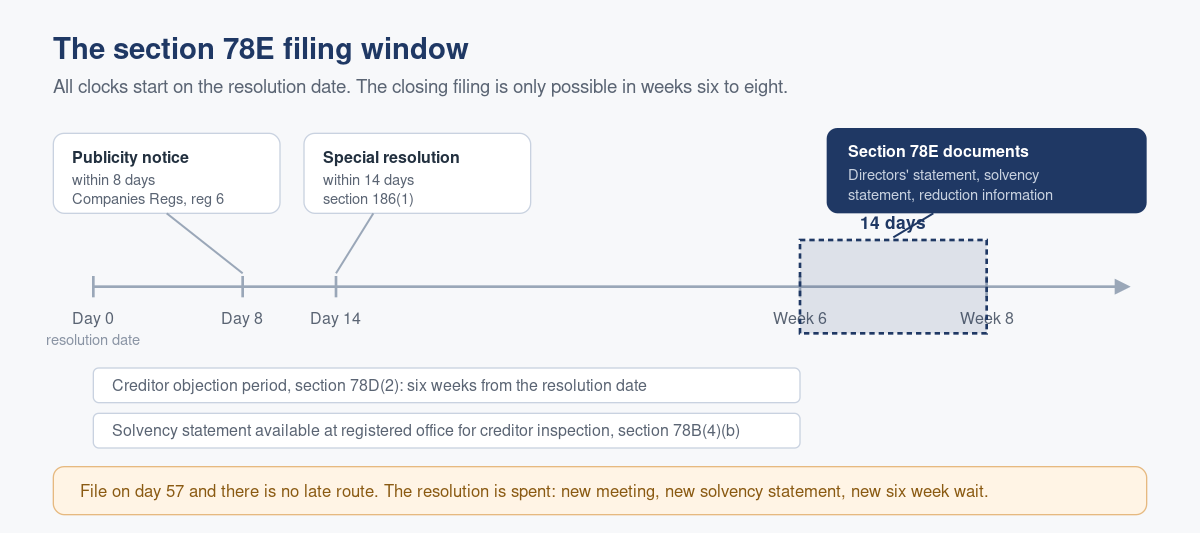
Your capital reduction does not happen when the members pass the special resolution. It happens when ACRA records the section 78E filing. And you can only make that filing after the end of six weeks and before the end of eight weeks from the resolution date, which is a window of exactly 14 days.
Raffles Corporate Services works with a panel of experienced Singapore law firms who offer cost-effective and efficient legal service and advice. This article is general information only and is not legal advice.
That single sentence is the whole reason this article exists. Companies run a clean reduction, get the solvency statement signed, lodge the publicity notice, then sit on it for three months because nobody diarised the back end. The resolution is spent, the money has often already moved, and the register still shows the old share capital.
Section 78E of the Companies Act 1967 is the closing filing on the non-court, solvency statement route to reducing share capital. It is free, processed immediately, and unforgiving about timing.
What section 78E actually does
Sections 78B and 78C let a private company and a public company respectively reduce share capital by special resolution, provided the company meets the solvency requirements and the prescribed publicity requirements. But both sections end with the same caveat: the resolution and the reduction take effect only as provided by section 78E.
Section 78E is that mechanism. Where the resolution has been passed, the publicity requirement met, the solvency requirement met where applicable, and no creditor has applied to court during the six weeks beginning with the resolution date, the company must lodge a defined bundle of documents with the Registrar.
Section 78E(5) fixes the moment of effect: the resolution and the reduction take effect when the Registrar has recorded the lodged information in the appropriate register. In Bizfile that is the same instant you submit. There is no approval queue and no waiting period at the end.
The three clocks you are running at once
The mistake is treating a capital reduction as one filing. It is a sequence, and the clocks run in parallel from the same starting gun, which is the resolution date.
| Obligation | Source | Deadline from resolution date | Fee |
|---|---|---|---|
| Lodge a copy of the special resolution | Section 186(1), Companies Act 1967 | Within 14 days | Prescribed lodgement fee |
| Lodge the publicity notice with the resolution text, resolution date and reduction information | Regulation 6(1), Companies Regulations, satisfying section 78B(1)(c) or 78C(1)(c) | Within 8 days | Prescribed fee, currently free in Bizfile |
| Creditor objection window | Section 78D(2) | 6 weeks, running | Not applicable |
| Make the solvency statement available at the registered office for creditor inspection free of charge | Section 78B(4)(b) | Throughout the 6 weeks | Not applicable |
| Lodge the section 78E documents | Section 78E(1) or (2) | After the end of 6 weeks and before the end of 8 weeks | Free |
Read that table twice. The first two deadlines are measured in days and fall in the same fortnight as the meeting. The last one does not open until six weeks have passed. Nothing you can do in week two moves it forward.
If you have not yet lodged the publicity notice, the section 78E filing is not available to you at all. Our companion piece on filing the publication for a proposed share capital reduction covers that step, and it is the one that must come first.
What you lodge, for a private company with no objections
This is the ordinary case: a private company limited by shares, a clean special resolution, no creditor has gone to court. Section 78E(1) requires the company to lodge:
- A copy of the resolution, in accordance with section 186. That is the 14 day filing, and it is separate from the rest.
- A copy of the solvency statement made under section 78B(3), if a solvency statement was required.
- A statement made by the directors confirming that the publicity requirement under section 78B(1)(c) and the solvency requirements under section 78B(3) have been complied with, and that no application to cancel the resolution has been made.
- A notice containing the reduction information.
Items 2, 3 and 4 are the ones that must land in the weeks six to eight window.
“Reduction information” has a statutory definition
Section 78A(4) defines it, and the definition is narrower than people assume. Reduction information means the amount of the company’s share capital that is thereby reduced, and the number of shares that are thereby cancelled. That is it.
In Bizfile you will also update the share capital and shareholding position after the reduction, shareholder by shareholder, because the electronic register of members has to end up correct. If the reduction takes a shareholder down to zero shares, the eService will ask you to confirm whether the company still qualifies as an exempt private company, since the shareholder count has just changed.
When a solvency statement is not needed at all
Section 78B(2) carves out reductions that do not involve a reduction or distribution of cash or other assets by the company, and do not involve a release of any liability owed to the company. The classic example is cancelling paid-up share capital that has been lost and is no longer represented by available assets, a purely accounting reduction under section 78A(1)(b) where nothing leaves the company.
There is then no solvency statement to make and none to lodge, and the directors’ statement confirms compliance with the publicity requirement only. Erring on the side of caution here is cheap: producing a solvency statement you did not strictly need costs you nothing. Erring the other way is not cheap at all.
What changes if a creditor objects
Under section 78D(2) and (3), any creditor whose debt or claim would be admissible in proof if the company were being wound up on the date of the application may apply to court during the six weeks beginning with the resolution date to have the resolution cancelled.
If that happens, the weeks six to eight window is replaced. Under section 78E(3) for a private company, the reduction can still take effect, but four conditions must be satisfied:
- The company must have notified the Registrar of each application as soon as possible, as section 78D(4)(b) requires.
- Proceedings on every application must have come to an end, either by dismissal under section 78F or without determination, for instance because the applicant withdrew.
- Within 15 days beginning with the date the last of those proceedings ended, the company must lodge the directors’ statement, now also confirming compliance with section 78D(4)(b) and how each application ended.
- For each application the court dismissed, the company must lodge a copy of the dismissal order.
Section 78E(4) does the same job for a public company. This is why the Bizfile form asks for the date of the last proceeding and the order of court dismissing the application, fields that stay blank in the ordinary case.
The practical consequence is a shorter fuse. Fifteen days from the end of proceedings is tight if the person holding the sealed order is counsel and the person doing the filing is the corporate secretary. Agree in advance who sends what to whom on the day the order is made.
Public companies are not the same filing
Section 78E(2) differs in one visible way: the documents to lodge in the weeks six to eight window do not include the copy of the resolution. A public company still lodges its special resolution under section 186 within 14 days, but section 78E(2) itself asks only for the directors’ statement and the notice containing the reduction information.
| Private company, section 78E(1) | Public company, section 78E(2) | |
|---|---|---|
| Underlying reduction power | Section 78B | Section 78C |
| Copy of resolution listed in section 78E | Yes, under section 186 | No, but section 186 still applies separately |
| Solvency statement lodged | Yes, if applicable | Not listed in section 78E(2) |
| Directors’ statement | Yes | Yes |
| Notice with reduction information | Yes | Yes |
| Window | After 6 weeks, before 8 weeks | After 6 weeks, before 8 weeks |
| If a creditor objects | Section 78E(3), 15 days from end of last proceedings | Section 78E(4), 15 days from end of last proceedings |
The steps in Bizfile, in order
You will be logged in as a business user through Corppass, or your corporate service provider will file from the firm’s own profile. If Corppass access is the part that is not working, start with our guide to logging in to Bizfile as a business user.
- Log in and confirm the correct entity is showing. Filing a capital reduction against the wrong entity in a group is expensive to unwind.
- Open the reduction of share capital eService. It will only offer the section 78E transaction if the publicity notice has already been lodged.
- Select the transaction for filing a reduction by special resolution under section 78E, and check the reduction details carried through from the publicity filing.
- Upload the directors’ statement and, where one was required, the solvency statement.
- Identify the directors who signed the solvency statement. Every director must have signed it. Directors not registered against the entity in ACRA’s records are entered manually.
- Update the share capital after the reduction: number of shares, issued share capital, paid-up share capital.
- Update the shareholding line by line.
- Review the before and after position, tick the declaration and submit.
There is no fee and no approval delay. Check the entity’s share capital and shareholder information straight afterwards and confirm the new figures are showing.
What goes wrong, and what it costs
Missing the eight week deadline. This is the big one. Section 78E permits lodgement only before the end of eight weeks beginning with the resolution date, and a late resolution cannot be rescued. You go back to the beginning: fresh notice of meeting, fresh special resolution, fresh solvency statement, fresh publicity filing, fresh six week creditor window. On a restructuring with a completion deadline, losing ten weeks is not a filing problem, it is a deal problem.
A stale solvency statement, or a director who did not sign. Section 78B(3)(b) requires the statement to be made in time to be circulated with the written resolution or made available at the meeting, and not before the beginning of the period of 20 days ending with the resolution date. Signed too early and it is not a compliant statement, so the solvency requirement was never met and section 78E was never available. All the directors must sign, too. Not a quorum, not the ones who were in the country. Section 7A(6) makes it an offence for a director to make a solvency statement without reasonable grounds for the opinions expressed in it, punishable by a fine of up to $100,000 or imprisonment of up to three years, or both. The same architecture appears in a members’ voluntary liquidation, covered in the declaration of solvency and directors’ personal liability.
Paying the money out before the filing. The reduction takes effect on recording by the Registrar. If cash goes back to shareholders in week three, the company has distributed capital before it had authority to reduce it. That is a problem for the directors and for the auditor, and it is the most common reason we are asked to review a reduction after the event.
Losing the inspection obligation. Section 78B(4)(b) requires the solvency statement or a copy to be available at the registered office, free of charge, to any creditor, throughout the six weeks. A breach does not invalidate the resolution under section 78B(5), but every officer in default is guilty of an offence. Since ACRA abolished the fixed three hour opening rule, how a creditor actually gets access is a live question, covered in our note on the registered office opening hours change.
Frequently asked questions
When exactly does my capital reduction take legal effect?
When the Registrar records the lodged information in the appropriate register, under section 78E(5) of the Companies Act 1967. Not on the date of the special resolution, and not on the date the board decided. In Bizfile the recording happens on submission, so the effective date is the date of your section 78E filing.
Can I file the section 78E documents early if no creditor has objected?
No. Section 78E requires lodgement after the end of six weeks beginning with the resolution date. The six weeks is the creditor objection period under section 78D(2) and it cannot be shortened or waived by consent, even in a wholly owned subsidiary with a single shareholder and no external creditors.
What happens if I miss the eight week deadline?
The resolution can no longer be given effect through section 78E. There is no late filing route and no penalty you can pay to fix it. The company must pass a new special resolution and run the entire sequence again, including a new solvency statement and a new six week creditor window.
Do I need a solvency statement for every capital reduction?
No. Section 78B(2) removes the solvency requirement where the reduction does not involve any reduction or distribution of cash or other assets by the company and does not involve releasing any liability owed to the company. Writing off share capital that is lost and unrepresented by available assets usually falls within that carve out.
Is there a filing fee, and who can make the filing?
There is no fee for the section 78E filing and it is processed immediately. A position holder, typically a director or the company secretary, can file directly through Corppass, or a registered corporate service provider can file from its own Bizfile profile. The obligations under sections 78B and 78E remain the company’s and the directors’ either way.
Getting the back end of a reduction right
A capital reduction is a project with a dead zone in the middle. Weeks one and two are busy, weeks three to six are silent, and then a 14 day window opens and closes. Almost every failed reduction we are asked to fix failed in that silence.
That is a diary problem more than a legal one, and it is the sort of thing Raffles Corporate Services is built to hold for you. We run the resolution, the solvency statement mechanics, the publicity filing, the inspection obligation and the section 78E lodgement as one dated plan, and we tell you the exact date the window opens and the date it shuts before the members ever vote.
If a reduction is part way through and you are not certain where it sits on the clock, that is a short conversation. You can reach us through Raffles Corporate Services, or read more at Singapore Secretary Services. For the primary sources, see section 78E of the Companies Act 1967 and ACRA’s page on reducing share capital.
— The Editorial Team, Raffles Corporate Services
Need help with corporate secretarial or compliance matters?
If you would like help with your company's corporate secretarial, governance or compliance requirements, email [email protected] or WhatsApp +65 8501 7133.
Our team can assist with corporate secretarial, accounting and tax matters. Where legal advice is needed, advisers from our associated law firms can assist.