

A foreign company registered in Singapore must keep its ACRA record current, and most changes carry a 30-day filing deadline. That covers the head office’s own details, the authorised representatives and directors, the constitutional documents, and the public register of members kept in Singapore.
Raffles Corporate Services works with a panel of experienced Singapore law firms who offer cost-effective and efficient legal service and advice. This article is general information only and is not legal advice.
This is the part of running a Singapore branch that people forget exists. Registering the branch felt like the hard bit, so the assumption sets in that the work is done. It is not. A registered foreign company is a live entry on ACRA’s register, and the obligation is not to have filed correct information once but to keep it correct continuously.
The obligations sit in Part 11, Division 2 of the Companies Act 1967, which is the part of the Act dealing specifically with foreign companies. Section 386 provides for penalties under that Division. Nothing here is exotic, but it is easy to miss when the decision-makers sit in another time zone and nobody in Singapore has been told it is their job.
Here is the complete map.
What “a foreign company” means here
A foreign company, for ACRA’s purposes, is a company incorporated outside Singapore that has registered a place of business or is carrying on business in Singapore. In everyday language, the Singapore branch of an overseas parent.
The critical structural point is that a branch is not a separate legal person. It is the same company, operating here. So when the head office changes its name, restructures, or amends its constitutional documents in its home jurisdiction, those are not foreign events that Singapore can ignore. They are changes to the very entity on ACRA’s register, and they have to be reported here.
That distinction drives almost everything below. If you are still weighing the branch against a subsidiary or a representative office, our Singapore branch office of a foreign parent FAQ sets out the trade-offs, and the Singapore representative office three-year sunset FAQ covers the lighter-touch option and its expiry date.
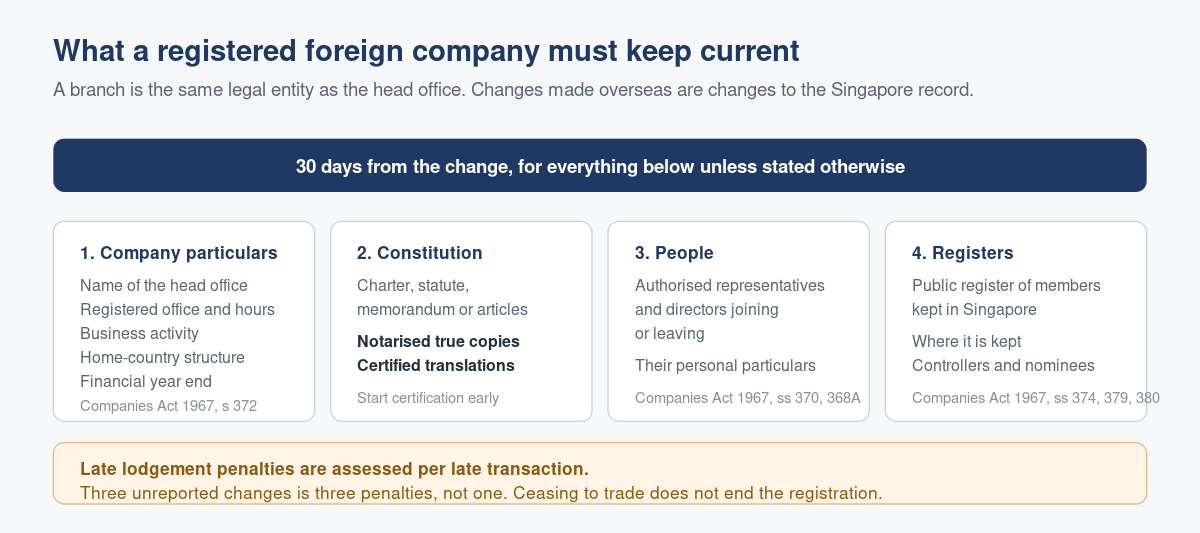
The four things that must be kept current
1. The company’s own particulars
Section 368 of the Companies Act 1967 sets out what a foreign company must lodge when it establishes a place of business here, and section 372 requires a return to be filed where those documents or particulars are subsequently altered. The practical list of triggers includes:
- The name of the foreign company, if the head office changes it
- The registered office address in Singapore, and its office hours
- The business activity carried on here, or a change in the legal structure of the company in its home jurisdiction
- The location where the branch register of members is kept
- The financial year end
The name change deserves a word of its own, because it is a two-step process and people routinely stop after step one. You apply to change the registered name, and then, once that application is approved, you separately update the entity information. Approval of the name is not the update.
2. Constitutional documents
If the charter, statute, memorandum or articles of the head office are amended, the amended documents have to be filed in Singapore within 30 days, together with an update to the entity information.
Two formalities catch people out here, and both cost time if you discover them late:
Certification. Supporting documents must be notarised or certified as true copies by a notary public before filing. A PDF emailed from the parent’s legal team is not enough.
Translation. Any document not in English needs a certified English translation. Where the translation is made outside Singapore, it must be certified by an official in the home country whose role is equivalent to ACRA’s and who holds the original, or by a notary public or sworn translator there, or by a Singapore consular officer in that country. Translations made in Singapore must be certified by a person approved by ACRA.
If your parent is in a jurisdiction where notarisation takes a fortnight, the 30-day clock is tighter than it looks. Start the certification chain on the day the amendment is passed, not on the day you think about filing.
3. Authorised representatives and directors
A foreign company must have at least one authorised representative who is ordinarily resident in Singapore, under section 370 of the Companies Act 1967. That person is the point of contact and, in practical terms, the person ACRA holds accountable for the branch’s filings.
Changes here are the most frequent filings a branch makes: representatives and directors joining or leaving, and their personal particulars changing. Both are on the 30-day clock. Section 368A imposes a corresponding duty on directors and authorised representatives to give the foreign company the information it needs to comply, so an individual who sits on their new address is part of the problem rather than a bystander.
This is a substantial topic on its own. The detail, including the full particulars ACRA requires and the difference between a residential address and a contact address, is in our companion guide on updating a foreign company’s representatives and directors.
4. The public register of members
A registered foreign company must keep a public register of its members in Singapore, available for public inspection. Sections 379 and 380 of the Companies Act 1967 deal with the register of members of foreign companies and with the contents of that register and its index. Section 374 requires a return to be filed regarding the keeping of registers.
Two things follow. The register has to exist and be accurate, and ACRA has to know where it is kept. Move the register, for example when you change corporate secretary or move office, and that is itself a change to be notified.
The obligations at a glance
| What changed | What to file | Deadline |
|---|---|---|
| Head office name | Name change application, then update entity information | Update within 30 days of approval |
| Registered office address or office hours in Singapore | Update entity information | 30 days |
| Business activity or home-jurisdiction legal structure | Update entity information | 30 days |
| Location of the branch register of members | Update entity information | 30 days |
| Charter, statute, memorandum or articles | Update entity information plus certified supporting documents | 30 days |
| Authorised representative or director joins or leaves | Appointment or withdrawal of position holder | 30 days |
| Particulars of a representative or director | Update position holder details | 30 days |
| Financial year end | Change of FYE | Per the FYE change process |
Who is actually liable
Directors and the company secretary must report these changes. Saying the head office did not tell you is not a defence, and neither is saying the change happened overseas.
Late filings attract late lodgement penalties, assessed per late transaction. A branch that lets a year drift with three unreported changes is not facing one penalty, it is facing three. The compounding is what turns an administrative oversight into a number that gets noticed in a group audit.
Beyond the money, a stale record has practical consequences. Banks refuse to act on outdated signatory information. Landlords and counterparties run a Bizfile search and find a representative who left eighteen months ago. Due diligence in a group transaction surfaces the gap at the worst possible moment.
The obligations people forget entirely
Financial statements. Section 373 of the Companies Act 1967 deals with the financial statements a foreign company must lodge. A branch is not exempt from filing simply because the accounts are prepared abroad.
Registrable controllers. A registered foreign company must maintain a register of registrable controllers, and the nominee director and nominee shareholder register requirements apply as well. ACRA has sharpened its approach here, as covered in our note on tougher penalties for the registers of nominee directors, nominee shareholders and controllers.
Ceasing business. Section 377 of the Companies Act 1967 addresses cesser of business in Singapore. Walking away from a branch without formally notifying ACRA leaves a live registration, with live obligations, generating penalties for a business that no longer exists.
Business activity codes. A change in what the branch actually does may require the activity code on the record to change. The migration to the current classification is covered in our piece on the SSIC 2025 business activity code update.
What goes wrong in practice
The failure mode is almost never refusal. It is distance.
A parent company in Frankfurt amends its articles. The general counsel there files the amendment with the local commercial register, ticks it off, and never thinks about Singapore, because Singapore is a small branch and nobody told him it mattered. The authorised representative in Singapore does not know the articles changed. Thirty days pass. Then a year passes.
The fix is structural, not heroic: one named person in Singapore who receives notice of every corporate change at the parent, and one standing instruction at the parent that Singapore gets copied. Diarise a quarterly reconciliation of the ACRA record against what the parent actually looks like today. Set up ACRA notifications so deadlines are not invisible, as explained in our guide to the ACRA alerts companies miss.
Frequently asked questions
How long does a foreign company have to report a change to ACRA?
Thirty days for the changes in this guide, including changes to company particulars, constitutional documents, authorised representatives and directors. The clock runs from the change itself, not from the date the Singapore office is told about it. Late filings attract late lodgement penalties assessed per transaction.
Does the head office changing its name overseas affect the Singapore branch?
Yes. A branch is the same legal entity as the head office, so a name change abroad must be reflected here. You apply to change the registered name in Singapore and then, after that application is approved, separately update the entity information. Stopping after approval leaves the record inconsistent.
Do foreign company documents need to be translated and certified?
Yes. Supporting constitutional documents must be notarised or certified as true copies by a notary public. Documents not in English need a certified English translation, certified by a qualifying official or sworn translator in the home country, a Singapore consular officer there, or an ACRA-approved person in Singapore.
Must a foreign company keep a register of members in Singapore?
Yes. A registered foreign company must maintain a public register of members in Singapore, open to public inspection, and ACRA must be told where that register is kept. Sections 379 and 380 of the Companies Act 1967 deal with the register and its required contents.
Who is responsible if the branch fails to file on time?
Directors and the company secretary are responsible for reporting changes, and the Singapore-resident authorised representative is the practical accountable party. Section 368A obliges directors and authorised representatives to supply the company with the information it needs, so individuals cannot simply stay silent.
What happens if the branch stops trading in Singapore?
Ceasing to trade does not end the registration. Section 377 of the Companies Act 1967 deals with cessation of business in Singapore, and the registration must be formally dealt with. An abandoned branch remains on the register and continues to generate obligations and penalties.
Keeping a branch tidy from a distance
Branch compliance is not difficult. It is just invisible from head office, which amounts to the same thing until a penalty notice or a due diligence request makes it visible.
Raffles Corporate Services acts as authorised representative and corporate secretary for foreign companies operating in Singapore, files changes inside the 30-day window, manages the notarisation and translation chain for overseas constitutional documents, and reconciles the ACRA record against the parent’s position before each year end. If your group is considering bringing the entity itself into Singapore rather than running a branch, our re-domiciliation FAQ is the place to start.
The Companies Act 1967 is on Singapore Statutes Online, and further reading on Singapore corporate secretarial practice is at Singapore Secretary Services.
— The Editorial Team, Raffles Corporate Services
Need help with corporate secretarial or compliance matters?
If you would like help with your company's corporate secretarial, governance or compliance requirements, email [email protected] or WhatsApp +65 8501 7133.
Our team can assist with corporate secretarial, accounting and tax matters. Where legal advice is needed, advisers from our associated law firms can assist.