

Most resolutions your company passes never go to ACRA. The ones that must are, broadly, every special resolution, every resolution that binds a class of shareholders, and a short list of resolutions that individual sections of the Companies Act 1967 single out. You have 14 days from the date the resolution is passed.
Raffles Corporate Services works with a panel of experienced Singapore law firms who offer cost-effective and efficient legal service and advice. This article is general information only and is not legal advice.
That rule lives in section 186 of the Companies Act 1967, and it is the single most useful provision to have in your head when someone asks whether a particular board or shareholder decision needs filing. The board resolution approving your annual accounts does not. The shareholders’ resolution changing your constitution does, and by a different route again.
This is the map. If you already know which resolution you are filing and just want the button sequence, skip to the companion guides on ordinary resolutions and special resolutions.
The rule in section 186
Section 186(1) requires a copy of two categories of resolution to be lodged with the Registrar within 14 days after it is passed or made, except where the Act expressly provides otherwise:
- Every special resolution. No qualification, no threshold, no materiality test. If it was passed as a special resolution, it is lodgeable.
- Every resolution which effectively binds any class of shareholders, whether or not all the members of that class agreed to it. Section 186(1)(b) also names one resolution specifically: the resolution under section 175A(1)(a) by which a private company dispenses with holding annual general meetings.
Section 186(3) makes default an offence. The company and every officer in default are each liable on conviction to a fine not exceeding $1,000, and also to a default penalty.
The phrase doing the quiet work is “except where otherwise expressly provided by this Act”. Several sections override the general 14-day rule with their own timing, and one of them reverses it. Those are set out below.
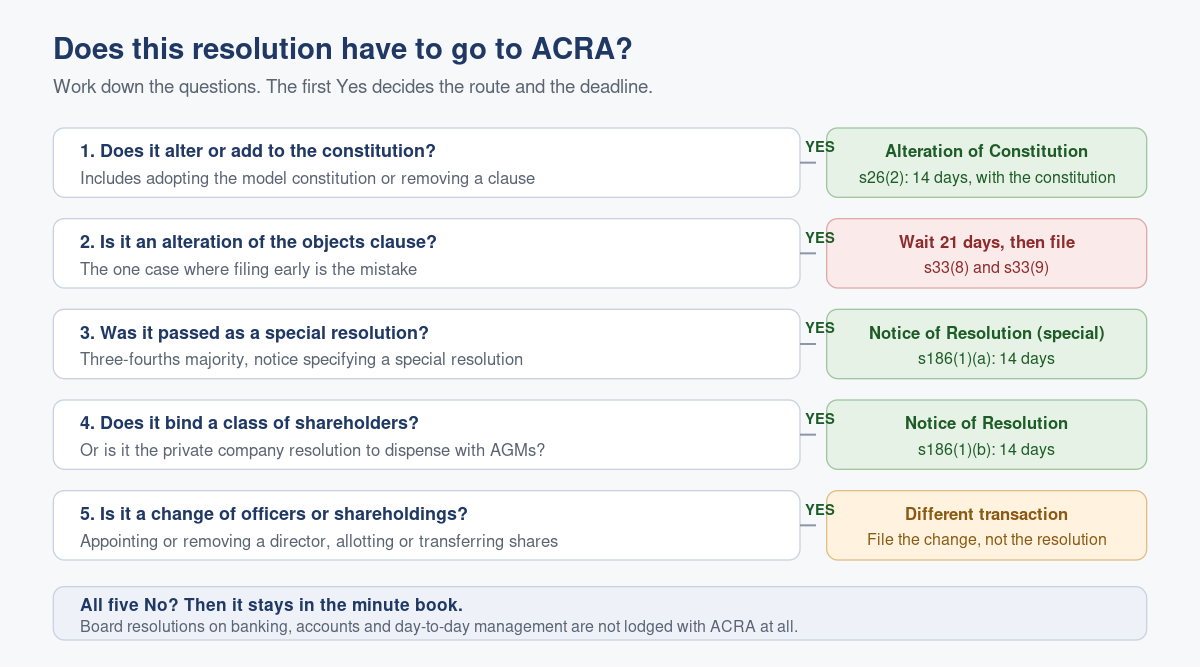
The decision, in one table
| Resolution | Lodge with ACRA? | Why |
|---|---|---|
| Any resolution passed as a special resolution | Yes, within 14 days | Section 186(1)(a) |
| Resolution altering or adding to the constitution | Yes, within 14 days, with the altered constitution | Section 26(2), filed as an alteration of constitution |
| Resolution altering the objects in the constitution | Yes, but not before 21 days have passed | Sections 33(8) and 33(9) |
| Private company resolution to dispense with AGMs | Yes, within 14 days | Named in section 186(1)(b) |
| Resolution that effectively binds a class of shareholders | Yes, within 14 days | Section 186(1)(b) |
| Ordinary resolution appointing a director | No notice of resolution filing; file the change of officer instead | Section 149B appointment, notified through the officer update transaction |
| Ordinary resolution removing a director | No notice of resolution filing; file the cessation instead | Sections 152(1) and 152(9) |
| Board resolution approving accounts, banking or day-to-day matters | No | Not caught by section 186 |
| Notice to members on financial assistance under section 76 | Yes, as its own sub-transaction | Section 76 notice obligations |
The last two rows in the “no” column are where companies waste time. Appointing or removing a director is notified to ACRA as a change in officers, not as a notice of resolution. Filing the resolution as well is harmless but pointless, and filing only the resolution leaves the register wrong.
The four sub-transactions on Bizfile
The Notice of Resolution eService is not one form. You choose a type of notice and the form changes underneath you. There are four:
Notice of resolution (ordinary resolution)
For an ordinary resolution that needs to reach the Registrar. You give the date of the meeting and a description of the resolution, and upload the resolution as a PDF. No fee, processed immediately. See our full walkthrough of the ordinary resolution filing.
Notice of resolution (special resolution)
The workhorse of the four, because section 186(1)(a) catches every special resolution. Covered in detail in our guide to filing a special resolution.
Copy of minutes by a representative of a holding company
Used where the minutes are signed by a representative of the holding company rather than produced in the usual way. You give the date the minutes were signed and attach them. This option also appears as a tick-box inside the other sub-transactions, which is why people file it twice.
Notice to a member on giving financial assistance under section 76
This one is narrow and only applies to a public company, or a company whose holding company or ultimate holding company is a public company. Section 76 prohibits those companies from giving financial assistance in connection with the acquisition of their own shares, subject to exceptions. Two of the exceptions, in sections 76(9A) and 76(9B), work only if the company gives members a notice containing prescribed particulars within a set period, and that notice is what this sub-transaction lodges. If you are a private company with no public company above you, this is not your filing.
Where the constitution filing sits instead
There is one important carve-out. If the resolution alters the constitution, it does not go through the Notice of Resolution eService. It goes through the Application for Alteration of Constitution eService, because section 26(2) requires the company to lodge the resolution together with a copy of the constitution as adopted or altered, unless the Registrar dispenses with it.
That matters more than it looks. Filing a constitutional amendment as a plain notice of resolution leaves ACRA holding a resolution that changes a document it has not received, and your company’s registered constitution stays out of date. The consequences turn up when a bank, an auditor or a buyer downloads the constitution and it does not match the resolutions in the file. Our guide to filing an alteration of constitution covers the three routes and the section 33 waiting period.
What goes wrong in practice
The resolution was never passed as a special resolution. This is the most common and the most expensive error, because you cannot fix it by filing. Section 184(1) requires a majority of not less than three-fourths of the members entitled to vote and voting, at a general meeting for which at least 14 days’ written notice was given by a private company, or 21 days by a public company, specifying the intention to propose the resolution as a special resolution. If the notice did not say so, you have an ordinary resolution wearing the wrong label. Short notice is available under section 184(2) only where members holding at least 95% of the total voting rights agree.
A written resolution was used where written resolutions are not allowed. Sections 184A to 184F let a private company or unlisted public company pass resolutions by written means: 75% of total voting rights for a special resolution under section 184A(3), a simple majority for an ordinary resolution under section 184A(4). But section 184A(2) excludes two things outright: a resolution to dispense with AGMs under section 175A(1)(a), and any resolution for which special notice is required. Companies get this wrong on the AGM dispensation in particular, which also needs the agreement of all members voting at the meeting under section 175A(2), not a majority.
Special notice was not given. Where the Act requires special notice, section 185 sets the clock at not less than 28 days before the meeting, and the company must then notify members with the notice of meeting or, failing that, at least 14 days before. Removing a director of a public company under section 152(2) is the classic case.
The 14 days ran from the wrong date. It runs from the passing of the resolution, not from the date the minutes were signed, circulated or approved at the following meeting. For a written resolution, it runs from the date the resolution was formally agreed.
The filing was late and nobody noticed. Late lodgement attracts ACRA’s late lodgement penalties on top of the statutory fine under section 186(3). The penalty applies per transaction, so a company that lets several resolutions drift accumulates a bill that is out of proportion to the underlying event.
Frequently asked questions
Do I have to file every resolution my company passes?
No. Section 186 of the Companies Act 1967 catches every special resolution and every resolution that effectively binds a class of shareholders, plus a private company’s resolution to dispense with AGMs. Ordinary board resolutions on day-to-day matters are not lodged with ACRA at all.
How long do I have to lodge a resolution?
Fourteen days from the date the resolution is passed, under section 186(1). Two exceptions matter: a constitutional change follows section 26(2), also 14 days, and an alteration of objects under section 33 must not be lodged until 21 days after the resolution, then within 14 days of that.
Does it cost anything to file a notice of resolution?
No. ACRA charges no fee for the notice of resolution transaction, and most filings are processed immediately. The cost of getting it wrong is the late lodgement penalty plus a fine not exceeding $1,000 for the company and each officer in default.
Is a director’s appointment filed as a notice of resolution?
No. A director may be appointed by ordinary resolution under section 149B, but ACRA is notified through the change of officers transaction, which updates the register of directors. Filing the resolution instead leaves the register showing the old board.
Can I file a written resolution rather than minutes of a meeting?
Usually yes. A private company or unlisted public company may pass resolutions by written means under section 184A, and the signed written resolution is what you upload. The exceptions are a resolution to dispense with annual general meetings and any resolution requiring special notice.
What if I discover a resolution from two years ago was never filed?
File it now. The obligation does not lapse, and a voluntary late filing with the penalty paid is a far better position than an unrecorded constitutional or class-binding change that surfaces during due diligence or a bank review.
Keeping the filing calendar and the minute book in step
The failure mode here is almost never legal. It is administrative. A resolution gets passed properly, signed properly, filed in the right folder, and nobody tells the person who lodges things with ACRA.
Raffles Corporate Services drafts resolutions, checks the notice periods and majorities before the meeting rather than after it, and lodges within the statutory window. If you suspect a resolution has slipped, we can reconcile your minute book against what ACRA actually holds. For the wider statutory picture, see our Companies Act 1967 deep-dive FAQ and the note on common mistakes and rejection reasons, or read more on Singapore corporate secretarial practice at Singapore Secretary Services.
— The Editorial Team, Raffles Corporate Services
Need help with corporate secretarial or compliance matters?
If you would like help with your company's corporate secretarial, governance or compliance requirements, email [email protected] or WhatsApp +65 8501 7133.
Our team can assist with corporate secretarial, accounting and tax matters. Where legal advice is needed, advisers from our associated law firms can assist.