
You register a sole proprietorship or partnership on Bizfile after your business name has already been approved. The registration fee is $100 for one year. Most registrations are approved within minutes of payment, provided nothing triggers a referral.
Raffles Corporate Services works with a panel of experienced Singapore law firms who offer cost-effective and efficient legal service and advice. This article is general information only and is not legal advice.
The filing itself is the easy part. What catches people out is everything that has to be true before Bizfile will let you submit, and the fact that only one specific person is allowed to do the submitting.
Under section 5 of the Business Names Registration Act 2014, a person and their business name must be registered before they carry on business in Singapore. Not after the first invoice. Before.
If you are still deciding between structures, start with the sole proprietorship and partnership in depth and the overall route from decision to UEN.
Do you actually need to register?
Not everyone does. Section 4 of the Business Names Registration Act 2014 lists who is outside the requirement, and two of those exemptions are common.
An individual carrying on business under only their own full name, exactly as it appears on their NRIC or passport, is not required to register. So is a firm of two or more individuals carrying on business under only the full names of all of them.
The word doing the work is only. “Tan Wei Ming” is outside the requirement. “Tan Wei Ming Consulting” is not, because the added word makes it a business name. This trips up freelancers constantly, usually at the point where a client’s procurement team asks for a UEN.
Certain registered professionals whose practice is governed by other written law are also outside the requirement. Anyone who is not required to register may choose to, and the Act then applies to them for as long as they are registered.
Carrying on business while required to be registered and not being registered is an offence under section 35, carrying a fine of up to $10,000 or imprisonment of up to two years, or both. There is also a practical cost that arrives sooner: without a UEN you cannot open a business bank account, bill a government agency, or satisfy most corporate procurement checks.
The three gates before you can file
Gate 1: an approved business name
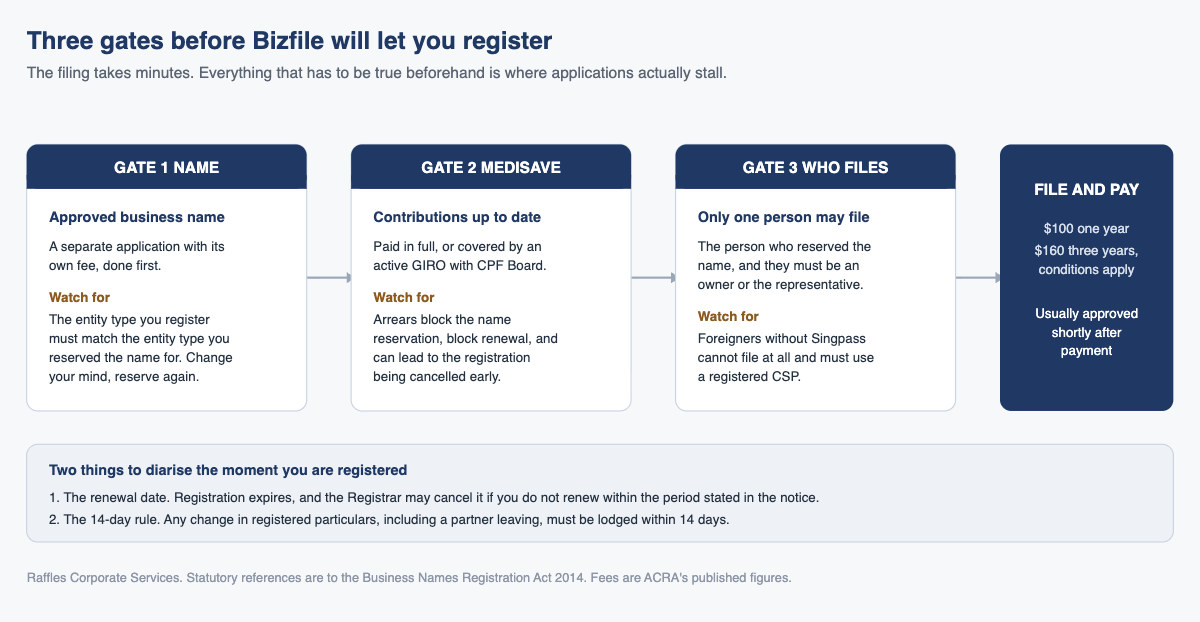
You must reserve the business name first, as a separate transaction. This is not a formality bundled into registration. It is a distinct application with its own fee, and it is where most rejections and delays happen. Our guide on what ACRA checks before approving a registration covers the referral and rejection side.
One detail that catches people: the entity type you register must match the entity type you chose when you reserved the name. If you reserved the name for a sole proprietorship and then decide to bring in a partner, you cannot simply register a partnership against that reservation. You reserve again.
Gate 2: Medisave
If you are self-employed, your Medisave contributions must be up to date before you can reserve a business name or become a new owner of an existing business. Up to date means paid in full, or covered by an active GIRO arrangement with the CPF Board.
This is the single most common reason a registration stops before it starts, and it usually surprises people who have been self-employed for a while without tracking it. It bites later too: outstanding Medisave blocks renewal, and persistent arrears can result in the registration being cancelled early.
Check your position through the CPF Board before you do anything else, and read our note on Medisave contributions for self-employed persons.
Gate 3: eligibility, and who is allowed to file
Owners must be at least 18, must not be undischarged bankrupts without the permission of the High Court or the Official Assignee, and must meet the residency criteria. Section 34 of the Business Names Registration Act 2014 makes it an offence for an undischarged bankrupt to carry on business, or to take part in the management of a registered business, without that permission.
Then there is the filing restriction, which is the one people most often get wrong: only the person who reserved the business name can register the business, and that person must be an owner or partner, or the authorised representative where none of the owners is locally resident.
Foreigners without Singpass cannot file at all and must engage a registered corporate service provider. Our Corporate Service Providers Act 2024 FAQ explains what that means in practice.
Where all the owners or partners live overseas, section 11 of the Act requires at least one authorised representative who is a natural person, at least 18, of full legal capacity and ordinarily resident in Singapore. That person is personally responsible for discharging the registered business’s obligations from the date of appointment, and is subject to the same liabilities and penalties in the event of default. It is not a nominal role.
What to have open before you start
| What you need | Detail that matters |
|---|---|
| Approved name and its eService number | Use it to pull the reservation details into the registration rather than re-keying them |
| Singpass (or Corppass, if a CSP is filing) | Individual users log in with Singpass |
| Proposed commencement date | The date the business will actually start, which can be later than the registration date |
| Business email address | Goes to ACRA, not to the public register |
| Business address | The main place you operate from. Not a P.O. Box. Home address only under the Home Office Scheme, with prior approval |
| Owner or partner particulars | NRIC or FIN, full name, date of birth, for every owner or partner |
| Residential address for every owner | ACRA sends official letters here |
| Contact address for every owner | This one is public. Must be in the same jurisdiction as the residential address, must be somewhere you can receive post, and cannot be a P.O. Box |
| Nominee or trustee details, if any | A nominee or trustee acting for the real owner must be registered as an owner or partner, with beneficiary and relationship details |
| Branch details, if any | Branch addresses and start dates |
The residential address and the contact address are not the same field
The consequences of confusing them are permanent and personal.
The residential address is where ACRA sends official correspondence. The contact address is displayed in ACRA’s public records. If you enter your home address in both, your home address becomes publicly searchable against your name for as long as the business is registered, and for as long as historical records exist afterwards.
There is no fee to register a contact address that differs from your residential address. Use your office, or your corporate service provider’s office, and do it at registration: unwinding it later means the earlier version has already sat in public records.
Running it from home
If you plan to operate a small-scale business from your home, you need approval under the Home Office Scheme before you register, from the Housing & Development Board if you live in an HDB flat, or from the Urban Redevelopment Authority if you live in private property. Getting this in the wrong order is a common and entirely avoidable delay.
The steps, in order
- Clear Medisave, secure any Home Office Scheme approval you need, and reserve the business name for the correct entity type.
- Log in to Bizfile. Individuals select the individual user route and authenticate with Singpass. A corporate service provider filing on your behalf uses Corppass and its own CSP dashboard.
- Open the registration eService for a new business entity.
- Retrieve the approved name using its eService number rather than typing the details again, then start the application.
- Enter the proposed commencement date, the business address and the business email address. For a partnership, state whether it is a professional partnership.
- Add each owner or partner as a position holder, individual or corporate, with their identification details, residential address and contact address.
- Declare any nominee or trustee arrangement, with the beneficiary details, at this stage rather than afterwards.
- Add any further owners or partners. A sole proprietorship has one owner. A general partnership has at least two and no more than 20, except for professional partnerships, which may have more.
- Select your registration period, review every field, read the declaration and tick it. The declaration is a statement of truth, not a formality.
- Pay. Consider whether you want a special unique entity number before you complete payment, because it is offered at this stage.
- Check your Bizfile inbox for the outcome.
What it costs and how long it takes
| Item | Amount or period |
|---|---|
| Registration, one year | $100 |
| Registration, three years | $160, available only where the CPF Board’s conditions are met |
| Name application | Charged separately when you reserve the name |
| Payment methods | Credit card, debit card or online banking |
| Straightforward applications | Usually approved shortly after payment |
| Complex applications | Up to 15 working days |
| Applications needing another authority’s approval | 14 to 60 days |
The three-year option is not automatic. It depends on conditions set by the CPF Board, so if your Medisave position is untidy, expect to be offered one year only. Our guide to paying ACRA on Bizfile covers receipts and failed payments.
After approval
Three things land in your Bizfile inbox: the notice of successful registration, your UEN, and a link to download a free copy of your Business Profile.
Download the Business Profile and read it line by line. It is the document every bank, landlord, insurer and corporate client will ask for, and it is the fastest way to catch a typo in an owner’s name or a wrong commencement date while it is still easy to correct.
Then put two things in your calendar.
The renewal date. Registration expires. Under section 14 of the Business Names Registration Act 2014, the Registrar then gives written notice that the registration may be cancelled unless it is renewed within a stated period, which must be at least 30 days from the notice. You remain registered until it is actually cancelled, but relying on that is a poor plan.
The 14-day rule for changes. Section 20 requires notice of any change in your registered particulars within 14 days. Where a person ceases to be a partner of a registered firm, that person and the continuing partners must lodge notice of the cessation within 14 days. Failure is an offence carrying a fine of up to $5,000 or imprisonment of up to 12 months, or both.
Set up ACRA’s alerts so the renewal notice does not arrive in an inbox nobody reads.
What goes wrong in practice
The entity type does not match the name reservation. You reserved for a sole proprietorship and now want two owners. The registration will not accept it, and you start the name process again.
Medisave arrears surface at the worst moment. Usually discovered at the name reservation stage, sometimes not until renewal a year later. Check it before you plan a launch date.
The home address goes into the public contact address field. Free to avoid at registration, impossible to fully undo afterwards.
A partner leaves and nobody files. The departing partner assumes the remaining partners will handle it. They do not. Because a general partnership carries unlimited personal liability, the public register still showing a departed partner is a live exposure for that person, not just an administrative untidiness.
Nobody registered at all. The business traded for a year under a trading name that was never registered, on the assumption that a name is just branding. That is the section 35 offence, and the fix is not retroactive.
When the business genuinely ends, cease it properly rather than letting the registration lapse. Our guide to closing a sole proprietorship or partnership sets out the cessation route.
Frequently asked questions
Can I register a sole proprietorship if I am on an Employment Pass?
Not on the strength of the pass alone. FIN holders must confirm with the authority that issued the pass, usually the Ministry of Manpower or ICA, that they are permitted to register and run a business. Registering without that confirmation puts your pass at risk.
Do I have to register if I am freelancing under my own name?
Not if you trade under only your full name as it appears on your identity document. Add any other word, such as a descriptor or a trading style, and registration becomes mandatory before you start carrying on business.
How many partners can a general partnership have?
Two at minimum and 20 at maximum. Professional partnerships formed by licensed professionals such as lawyers, engineers and architects may exceed 20. Beyond that ceiling, an ordinary partnership is not the right structure.
Can a company own a sole proprietorship?
Yes. A sole proprietorship can be owned by an individual, a company or a limited liability partnership. A company-owned sole proprietorship is sometimes used to run a distinct trading name under an existing corporate entity.
What happens if I miss the renewal?
The Registrar issues written notice that the registration may be cancelled unless you renew within a stated period of at least 30 days. You stay registered until cancellation actually happens, but once it is cancelled you are carrying on business unregistered, which is an offence.
How long before I can start trading?
Straightforward registrations are usually approved shortly after payment, so effectively the same day. Build in up to 15 working days for anything complex, and 14 to 60 days if your business activity requires another authority’s approval.
The part that outlasts the registration
Registering takes an afternoon. Staying registered, renewed, accurate and inside the 14-day window every time something changes is the part that runs for years, and the part that quietly goes wrong.
Raffles Corporate Services registers sole proprietorships and partnerships, acts as authorised representative where the owners are overseas, tracks renewal and Medisave dates, and files changes inside the statutory window. If your registration has drifted out of date, or you are not sure whether you should have registered at all, that is a short conversation.
You can reach us through Raffles Corporate Services, or read more on Singapore corporate secretarial practice at Singapore Secretary Services.
— The Editorial Team, Raffles Corporate Services
Need help with this?
Raffles Corporate Services can handle the ACRA filings, compliance documentation and records for you, and where court proceedings or legal advice are needed, we work with a panel of experienced Singapore law firms who offer cost-effective and efficient legal service and advice.
Email: [email protected]
Call, SMS or WhatsApp: +65 8501 7133