

You can run a defensible risk check on any Singapore business for nothing, and a thorough one for under $100. The method is four tiers deep, and you stop at whichever tier matches the money at stake. Most transactions never need to go past the second.
Raffles Corporate Services works with a panel of experienced Singapore law firms who offer cost-effective and efficient legal service and advice. This article is general information only and is not legal advice.
The reason to do this properly is not that fraud is rampant. It is that the cost of checking is trivially small compared with the cost of not checking, and the checks take minutes rather than days. A supplier who disappears with a deposit, a customer who takes sixty-day terms and then dissolves, a “director” who turns out to hold no position at all: each of these is visible in the register before the money moves, and invisible afterwards.
This article covers what you can establish from ACRA’s own records. Sources outside ACRA, which matter once a counterparty passes the register test, are covered separately in our note on checking whether a Singapore business is trustworthy.
What a basic risk assessment actually establishes
A basic risk assessment answers four questions, in this order:
- Does this entity exist, and is it currently live?
- Is the person dealing with me connected to it in the way they claim?
- Does the entity have any substance behind it?
- Can it pay?
Notice what is not on the list. The register cannot tell you whether the goods will arrive or whether the founder is honest. It tells you whether the counterparty is who they say they are and whether the shape of the entity fits the deal. That is a floor, not a ceiling, and treating it as the whole exercise is the most common mistake made with it.
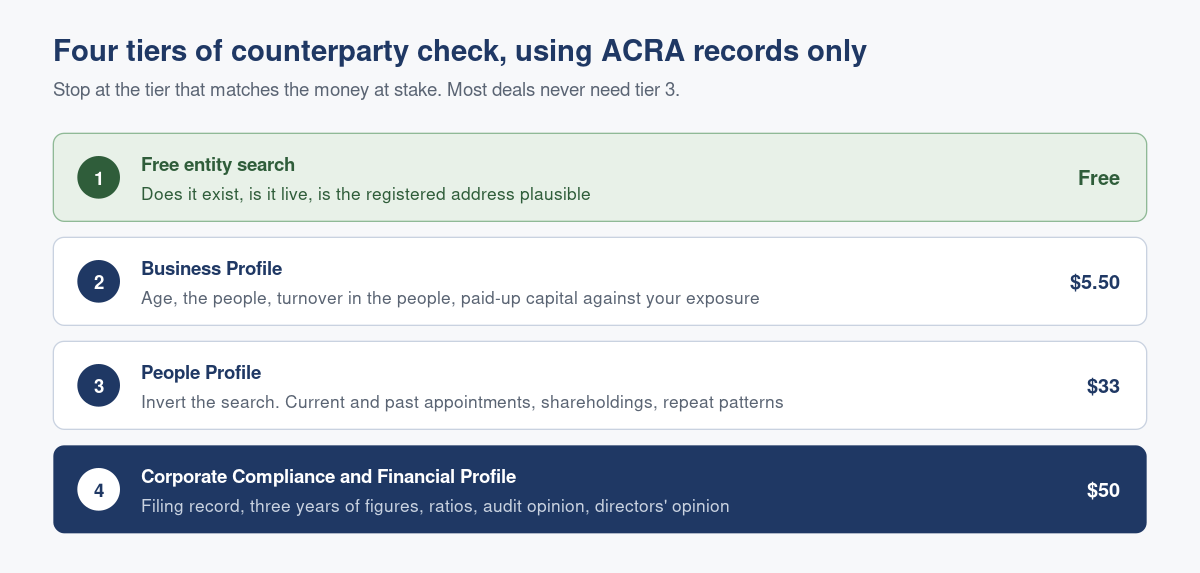
The four tiers
| Tier | What you do | What it costs | Use when |
|---|---|---|---|
| 1 | Free Bizfile entity search | Free | Every new counterparty, no exceptions |
| 2 | Buy a Business Profile | $5.50 | Any transaction worth more than a few hundred dollars |
| 3 | Buy a People Profile on the individual | $33 | Something about the person does not fit |
| 4 | Buy a Corporate Compliance and Financial Profile | $50 | You are extending credit or taking a stake |
What sits inside each of these is set out in our guide to the types of ACRA information products. If a counterparty sends you one rather than you buying it, check it first using verifying and certifying ACRA documents.
Tier 1: the free search
No login, no payment. Search the entity on Bizfile and establish two things: that its status is live, and that its registered address exists and is plausible. ACRA and the Singapore Land Authority also expose business locations through OneMap, which is a quick way to see what is actually at an address.
Then do the part that almost nobody does. Try the address. Not a site visit, just a look. If the registered address is a residential block and the counterparty is describing a warehouse operation, or if the address belongs to a serviced office suite shared by several hundred entities, you have not found wrongdoing, but you have found a question.
A registered address is where ACRA sends post. It is very frequently a corporate service provider’s address and implies nothing about where business is conducted. What matters is the mismatch between the register and what you were told.
Tier 2: the Business Profile
At $5.50 this is the tier that earns its keep. Read it for four things.
Age. The incorporation or registration date tells you how long the entity has existed. An entity incorporated six weeks ago that is asking for a large deposit is a different risk from one that has traded for eleven years. Neither is disqualifying. Both are relevant.
The people. Check that the person emailing you appears in the profile, and in the role they claim. “Managing Director” is a job title, not a statutory position, and plenty of people who genuinely run companies are not named in the register. But if the person signing the contract holds no position and is not a shareholder, ask who is authorised to bind the company, and get that person’s signature.
Turnover in the people. Frequent changes of directors, secretaries or shareholders over a short period is one of the more reliable soft signals in the register. It usually means instability rather than fraud, but instability is itself a payment risk.
Capital. Compare paid-up share capital against your exposure. A company with paid-up capital of $1 asking for $400,000 of unsecured credit is telling you something about how much of the risk its shareholders are willing to carry. That is legal, extremely common and not an accusation. It is simply a fact to price.
Tier 3: the People Profile
When the entity checks out but the person does not, invert the search. A People Profile shows an individual’s current and past appointments and their shareholdings across entities.
The pattern this exposes is the serial short-lived company: a string of entities incorporated, run briefly and wound up or struck off, often sharing a registered address, sometimes with overlapping names. One dissolved company in a career means very little. Six in five years means something.
Related warning signs worth weighing together: the new entity was incorporated shortly after an earlier one became uncontactable; both share a registered address; you are told the new entity has “taken over” from the old one; and you are asked to sign a fresh contract and pay again before a problem with the earlier entity will be resolved. Individually these are explicable. Together they are a pattern.
Tier 4: the CCFP
The Corporate Compliance and Financial Profile is the only ACRA product that gives you a view rather than a fact. For $50 it bundles the profile information with a compliance record, up to three years of comparative financial data, calculated ratios, the audit opinion and the directors’ opinion.
Two caveats. It depends on filed financial statements, and small solvent exempt private companies are generally not required to file theirs, so the financial section may be thin or empty. And filed accounts can be a year or more old. Neither makes it useless, but both make it a lagging indicator.
Where it is genuinely valuable is the compliance record. Whether annual general meetings were held on time and annual returns filed on time is a proxy for whether anyone is minding the shop. A company that files late and repeatedly is not necessarily in trouble, but it is a company whose administration is drifting, and administrative drift tends to arrive before financial drift.
Reading the ratios without being an accountant
| Ratio | What it is | Read it as |
|---|---|---|
| Current ratio | Current assets divided by current liabilities | Below 1.0 means short-term obligations exceed short-term assets. Ask how they intend to pay you. |
| Total liabilities to equity | Total liabilities divided by total equity | How much of the business is funded by debt. Higher means more fragile under stress. |
| Interest cover | Earnings before interest and tax divided by finance costs | How comfortably they service existing debt. Low cover means little headroom. |
| Net profit margin | Profit after tax as a percentage of revenue | Thin margins mean small shocks matter. |
None of these is a verdict on its own. Read them against the industry and against the trend over the three years shown. A current ratio of 0.9 in a business with fast inventory turnover is unremarkable. The same figure in a project business with long receivables is a question.
The audit opinion is the fastest read in the document
If filed accounts were audited, the opinion is the single most efficient thing in the CCFP.
An unqualified opinion means the auditor considers the statements to give a true and fair view. An emphasis of matter means the same, with a specific point the auditor wants you to notice, so go and read the note it points to. A qualified opinion means the statements are reliable except for identified issues. A disclaimer means the auditor could not gather enough evidence to form a view at all. An adverse opinion means the auditor considers the statements materially wrong.
A disclaimer or an adverse opinion on a counterparty you are about to extend credit to should stop the process until somebody senior has read the accounts properly. These are rare, and they are rare for a reason.
What goes wrong in practice
Checking the company and not the person. The entity is real, live and eleven years old. The person emailing you from a similar-looking domain has nothing to do with it. Every element of the check passed, and the money still went to the wrong bank account. Verify banking details by voice, on a number you sourced independently, not from the email.
Doing the check after the deposit. A risk assessment conducted after payment is an incident report. The whole value is in the sequencing.
Treating a live status as a solvency statement. “Live” means the entity has not been struck off or wound up. Companies in serious financial distress remain live for a long time.
Ignoring who owns the company behind the company. Where the shareholder is another entity, especially a foreign one, the profile shows you the immediate owner only. Identifying the human being at the end of the chain is a separate exercise, and our note on UBO identification in Singapore covers why that is harder than it looks.
Proportionality: how far to go
Match the tier to the exposure, and write down what you did.
- Under $1,000, or payment in advance from them to you: tier 1.
- A few thousand dollars, or any relationship you expect to repeat: tiers 1 and 2.
- Anything where the person is the deal rather than the company, or where something feels off: add tier 3.
- Credit terms, prepayment from you, an equity stake, or a long contract: all four tiers.
The file note matters as much as the check. If a transaction goes wrong, the question your bank, insurer or board will ask is what you knew and when. A dated PDF of the profile you pulled, with a two-line note of what you concluded, answers it. Be clear-eyed about what a free extract can and cannot establish, which our note on what a free ACRA register extract proves sets out.
Frequently asked questions
How much does it cost to check a Singapore company?
Nothing for the basic entity search, which confirms existence, status and registered address without a login. A Business Profile is $5.50 and answers most practical questions. A full check including a People Profile and a Corporate Compliance and Financial Profile comes to under $100 in total.
What does it mean if a company’s paid-up capital is $1?
It is legal and very common in Singapore, particularly for new and small companies. It means shareholders have committed almost nothing of their own money to the entity. If you are extending credit, it tells you there is little in the company to meet creditors if it fails, so price or secure accordingly.
The person contacting me is not listed in the business profile. Is that a problem?
Not necessarily. Employees and managers who genuinely run companies often hold no statutory position. It becomes a problem when they are signing contracts or giving payment instructions. Ask who is authorised to bind the company, and have that person confirm in writing.
How often should I re-check an existing supplier?
Run the free entity search annually on anyone you buy from regularly, and immediately if you notice a change of contact person, a change of bank details, a new entity name on an invoice, or a sudden shift in payment behaviour. Those four triggers catch most of what changes.
Making the check routine
The companies that get caught are rarely the ones that ran a bad check. They are the ones that ran no check, because nobody owned the task and the deal was moving fast. Fixing that is a process problem, not a research problem: one person, one short standard, one place the file notes live.
If you would rather that ran quietly in the background, or you want your own entity records in a state where counterparties checking you find nothing to worry about, speak to Raffles Corporate Services. For the mechanics, see buying a Business Profile via Bizfile, or read more on Singapore corporate secretarial practice at Singapore Secretary Services.
— The Editorial Team, Raffles Corporate Services
Need help with corporate secretarial or compliance matters?
If you would like help with your company's corporate secretarial, governance or compliance requirements, email [email protected] or WhatsApp +65 8501 7133.
Our team can assist with corporate secretarial, accounting and tax matters. Where legal advice is needed, advisers from our associated law firms can assist.