

There are six ACRA information products you can buy through Bizfile, and most people buy the wrong one. A Business Profile at $5.50 answers about eighty per cent of the questions anyone actually has. The $50 product answers a different question entirely, and the $33 one answers a question about a person rather than a company.
Raffles Corporate Services works with a panel of experienced Singapore law firms who offer cost-effective and efficient legal service and advice. This article is general information only and is not legal advice.
The confusion is understandable. The product names describe the format rather than the purpose, so you have to already know what is inside each one before you can choose sensibly. That is a poor way to design a shop, and it is the reason companies routinely pay for a Corporate Compliance and Financial Profile when they wanted a certified extract, or buy three separate documents when one would have done.
Here is what each product is, what it tells you, what it costs, and the free option most people overlook.
What is an ACRA information product?
An ACRA information product is a document generated from the Registrar’s records and sold through Bizfile. It is not a copy of something the company gave you. It is an extract from the statutory register itself, which is why banks, courts, landlords and counterparties treat it as evidence rather than as a claim.
The legal basis sits in the ACRA Act 2004, which governs what the Registrar holds, what may be disclosed and to whom. Some categories of information, notably residential addresses, are restricted and only released to a narrow class of requester under section 30B and the Sixth Schedule to that Act. Everything else in the register is public and purchasable by anyone, including someone in another country with no connection to Singapore at all.
That last point is worth sitting with. Your company’s officers, shareholders, share capital and registered address are visible to any person willing to pay a few dollars. So are your filed financial statements, if you filed them in full XBRL. Assume your counterparties are looking.
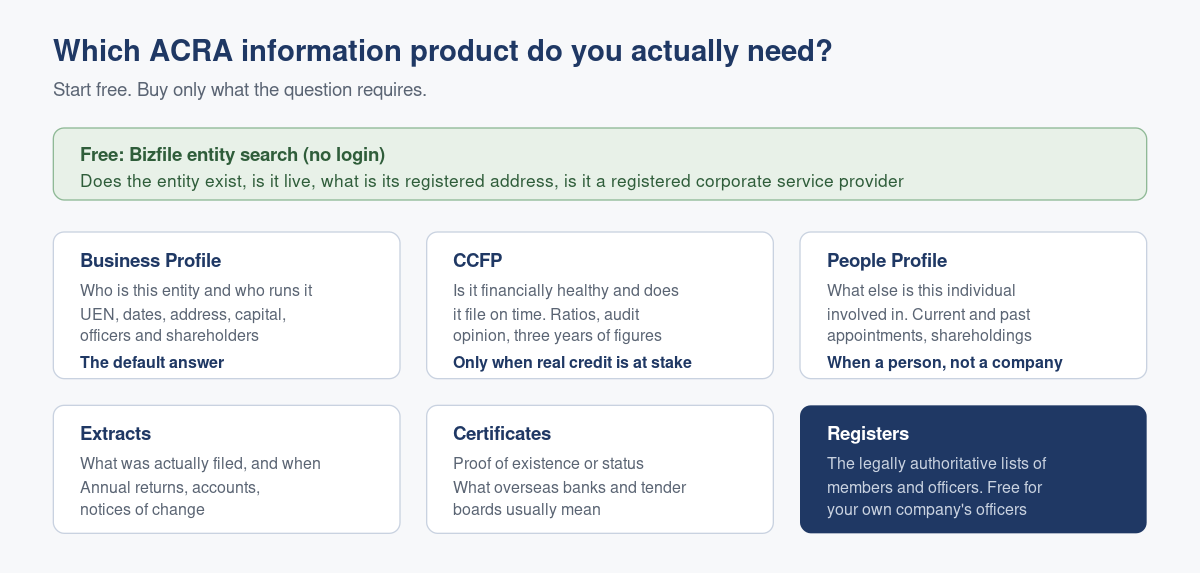
The six products, side by side
| Product | What it answers | Typical cost |
|---|---|---|
| Business Profile | Who is this entity, who runs it, when did it start, what capital does it have | $5.50 |
| Corporate Compliance and Financial Profile (CCFP) | Is this company financially healthy and does it file on time | $50 |
| People Profile | What else is this individual involved in, now and previously | $33 |
| Extracts | What exactly did this entity file on a particular date | From $11 |
| Certificates | Can I prove this entity exists or that this fact is true | From $11 |
| Registers | Who are the members, directors, CEOs, secretaries or auditors, officially | From $11 |
Business Profile
The workhorse. It gives you the UEN, the entity name and any former names, the registration or incorporation date, the registered address, principal activities, issued and paid-up share capital, and the particulars of officers, shareholders, owners or partners.
If someone asks you to “send over your ACRA”, this is what they mean. Banks opening an account, landlords granting a lease, government agencies assessing a grant, and finance teams onboarding a new supplier all want this document and nothing more.
Corporate Compliance and Financial Profile
The CCFP is the only product that gives you an opinion rather than a fact. It bundles the Business Profile information with a compliance record (whether annual general meetings were held on time and annual returns filed on time), up to three years of comparative financial data, calculated ratios covering liquidity, profitability, efficiency and solvency, the auditor’s opinion on the filed accounts, and the directors’ opinion.
It is worth the money in exactly one situation: you are about to take real credit risk on a Singapore company and you want a defensible file note showing you looked. Extending sixty-day payment terms on a large order, subcontracting a significant project, or taking a minority stake all qualify.
It is not worth the money for routine onboarding, and it is useless for a company that has never filed financial statements, which includes most small exempt private companies.
People Profile
This inverts the search. Instead of starting with a company and finding its people, you start with a person and find their companies: current appointments, past appointments, and shareholdings.
It is the single most useful product when something feels wrong about a counterparty, because patterns show up here that never show up in a company search. A director with eleven dissolved companies behind them is a different proposition from a director with one company of twelve years’ standing.
Extracts
An extract is a copy of a document the entity actually filed: an annual return, a set of financial statements, a notice of change in officers, a lodgement of a charge. Where a Business Profile tells you the current position, an extract tells you what was filed, when, and by whom.
Use extracts when the question is historical or forensic. “What did the shareholding look like in 2019” is an extract question. “Did they actually file the accounts they told us they filed” is an extract question.
Certificates
Certificates prove a state of affairs rather than describing it. The most commonly bought is the certificate confirming incorporation or registration, which foreign banks, overseas registries and tender boards routinely demand. Others confirm particular facts about an entity’s status.
Registers
Registers are the official lists of the people connected to a company: members, directors, chief executive officers, secretaries, auditors. Under the Companies Act 1967 the Registrar’s electronic register of members is the legal register for a private company, which means this document is not a summary of who owns the shares. It is the thing that determines who owns the shares.
If you are an active officer or member of the company, note that you may be able to obtain your own company’s registers free of charge rather than buying them. The paid product is for everybody else.
The free option almost nobody uses
Before you buy anything, run Bizfile’s free entity search. No login is required. It will tell you whether an entity exists, whether its status is live, what its registered address is, and whether a given entity is a registered corporate service provider.
For a large proportion of real-world questions that is the entire answer. If you are checking that the company invoicing you is the company you contracted with, or that a firm claiming to be a licensed corporate service provider actually is one, the free search settles it in thirty seconds.
If you are new to the platform, our guide to what Bizfile actually is and what you can and cannot do in it covers the layout, and your first fifteen minutes in Bizfile gets you oriented. Buying does not require a login, but doing anything on behalf of your own company does, which is covered in logging in to Bizfile as a business user.
What goes wrong in practice
Buying a Business Profile when the counterparty needed a certificate. An overseas bank asking for “proof of incorporation” will usually reject a Business Profile. They want the certificate. This costs people a week, because the rejection arrives by email four days later with no explanation of what would have been acceptable.
Buying a CCFP for a company with no filed accounts. Small exempt private companies that are solvent are not required to file their financial statements with their annual return. Buy a CCFP on one of these and the financial profile section will be thin or empty. You will have spent $50 to learn that they file their annual returns on time, which the compliance section of a much cheaper check would have suggested anyway.
Buying your own company’s registers. Active officers and members generally have a free route to their own registers. Paying for them is a small waste, repeated monthly across a portfolio of entities, that adds up to a real number.
Relying on a downloaded profile months later. An ACRA information product is a snapshot taken at the moment of purchase. A Business Profile bought in January says nothing about a director who resigned in March. For anything that matters, buy it fresh.
Assuming a registered address is a real office. The registered address is where ACRA sends post. It is very often a corporate service provider’s address, which tells you nothing about where the business actually operates or whether it operates at all.
Choosing in one line each
- You need to prove your own company exists to a bank or agency: Business Profile, or a Certificate if they specifically ask for proof of incorporation.
- You are onboarding a supplier or customer: free entity search, then a Business Profile if the amount at stake justifies it.
- You are extending meaningful credit: CCFP.
- Something about the person you are dealing with does not add up: People Profile.
- You need to see a historical filing: Extracts.
- You need the legally authoritative list of shareholders or officers: Registers.
Current pricing and product descriptions are published on ACRA’s own buying business information pages, which is worth a glance before a large purchase. Once you have the document, the next question is usually whether it is genuine, which our note on verifying and certifying ACRA documents answers, and what to do with it, which is covered in conducting a basic risk assessment with ACRA information.
Frequently asked questions
Do I need a Singpass or Corppass account to buy an ACRA information product?
Not for the free entity search, which requires no login at all. For purchases, Bizfile will ask you to log in and pay. If you are buying on behalf of your company rather than personally, you will need the company’s Corppass set up first, which is a separate exercise.
Can I get a company’s financial statements from ACRA?
Sometimes. Companies that are required to file financial statements do so with their annual return, and those filings can be bought as extracts or read through a CCFP. Small solvent exempt private companies are generally not required to file them, so for those companies there is nothing to buy.
Is an ACRA information product accepted as legal proof?
It is an extract from the Registrar’s records and is generally accepted as evidence of what the register contains. Where an authority requires certification, ACRA offers electronic certification of applicable products, and the Singapore Academy of Law can legalise certified documents for overseas use.
Can a foreigner with no Singapore connection buy information on a Singapore company?
Yes. Registered information about Singapore entities is public. The restriction sits on residential addresses, which are only disclosed to a limited class of requester under the ACRA Act 2004. Everything else is available to anyone who pays.
How current is the information I buy?
It reflects the register at the moment of purchase, not the real world. If a change occurred last week and nobody filed it, the product will not show it. Companies have a limited window to file most changes, so recent events may simply not be there yet.
Buying the right thing the first time
Most of the money wasted on ACRA information products is wasted on the wrong product rather than on too many of them. The individual amounts are small, which is precisely why nobody stops to think about it and the same mistake repeats across a hundred transactions a year.
If you are running regular counterparty checks and want a consistent standard applied to them, or you simply want your own entity records kept in order so that nobody has to buy anything urgently at five o’clock on a Friday, that is the sort of thing we take off your desk. Speak to Raffles Corporate Services, or read more on Singapore corporate secretarial practice at Singapore Secretary Services.
— The Editorial Team, Raffles Corporate Services
Need help with corporate secretarial or compliance matters?
If you would like help with your company's corporate secretarial, governance or compliance requirements, email [email protected] or WhatsApp +65 8501 7133.
Our team can assist with corporate secretarial, accounting and tax matters. Where legal advice is needed, advisers from our associated law firms can assist.