
The Green Mark Incentive Scheme for Existing Buildings 2.0 (GMIS-EB 2.0) is a Building and Construction Authority (BCA) grant that co-funds energy retrofits of privately owned existing buildings in Singapore with a gross floor area of at least 5,000 square metres. The building owner applies, and the building must go on to achieve Green Mark Platinum, Super Low Energy or Zero Energy certification. Funding is outcome-based: S$25, S$35 or S$45 per tonne of carbon abated, capped at S$600,000, S$900,000 or S$1.2 million, and never more than 50% of qualifying cost. The scheme runs until 31 March 2027 or until funds are fully committed, whichever is earlier.
Raffles Corporate Services works with a panel of experienced Singapore law firms who offer cost-effective and efficient legal service and advice. This article is general information only and is not legal advice.
What does GMIS-EB 2.0 actually pay for?
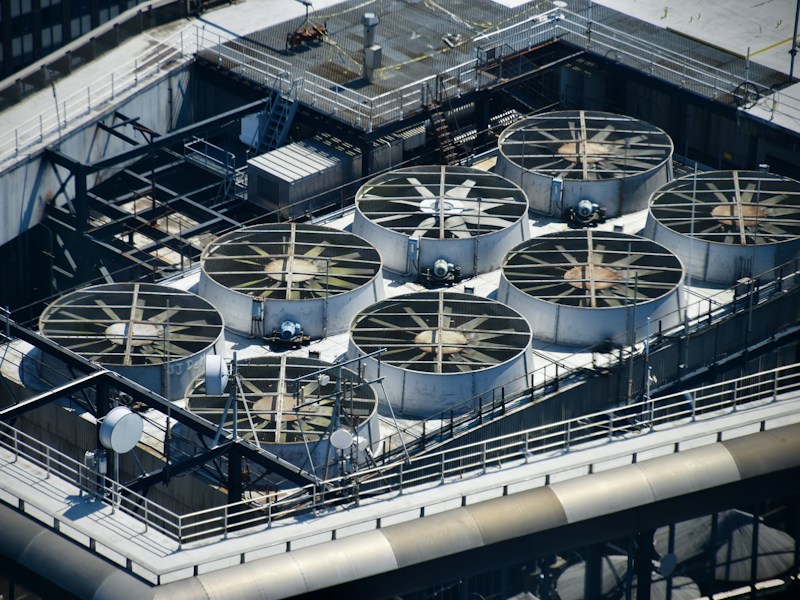
The scheme pays for Energy Improvement Works (EIWs): retrofit works that reduce a building’s energy use and therefore its carbon emissions. BCA’s FAQ says any works that improve the building’s energy performance can be considered, and gives examples such as cooling system retrofits, converting air-conditioned areas to natural ventilation, and installing on-site solar panels.
BCA’s non-exhaustive list of eligible equipment includes:
- High-efficiency chillers, chilled water pumps, condenser water pumps and cooling towers
- Chiller plant energy optimisation systems and auto condenser tube cleaning systems
- Building automation systems and variable speed drives
- Efficient air handling units and fan coil units, and unitary systems such as 5-tick VRV/VRF
- LED lighting, photo sensors, motion sensors, CO2 sensors for AHUs and CO sensors for carpark ventilation
- Heat pipes and energy recovery wheels
- Energy-efficient lifts and escalators, and regenerative drives for lifts
- On-site photovoltaics or other renewable energy sources
Equipment that is not on the list is subject to BCA’s review and approval. The grant is not a general renovation fund: the amount depends on the carbon reduction that the works achieve, not on how much the owner spends.
Who is eligible?
The applicant must be the owner of a privately owned existing building in Singapore with a gross floor area of at least 5,000 square metres. Eligible building types are:
| Building type | What counts | Key restriction |
|---|---|---|
| Commercial and institutional | Hotels, offices, retail buildings, healthcare facilities, community institutions | Must be privately owned |
| Light industrial | Buildings where the company’s business activity falls within the building-sector SSIC codes BCA lists | Energy savings from manufacturing, industrial and commercial processes are excluded |
| Residential | Condominiums and other private residential developments | Only savings from common areas and common services count |
BCA’s FAQ also states that:
- Data centres are not eligible.
- Privately owned buildings that are fully or partly government-funded are not eligible.
- Buildings that apply for GMIS-EB 2.0 may not also apply for other government-funded sustainability incentive schemes for the building, and owners must declare upfront any BCA or other agency schemes the building has used.
- Buildings that benefited from the earlier GMIS-EB or GMIS-EBP can apply, but works funded under those schemes that are still within their useful life are excluded from the grant calculation.
- A building that has already completed verification and received a Green Mark 2021 Letter of Clearance at Platinum, SLE or ZE level is not eligible.
How much funding can a building owner get?
The funding factor and cap depend on the Green Mark 2021 certification level the building achieves after the retrofit.
| Green Mark level achieved | Funding factor | Funding cap |
|---|---|---|
| Green Mark Platinum | S$25 per tonne CO2e | S$600,000 or 50% of qualifying cost, whichever is lower |
| Green Mark Super Low Energy (SLE) | S$35 per tonne CO2e | S$900,000 or 50% of qualifying cost, whichever is lower |
| Green Mark Zero Energy (ZE) | S$45 per tonne CO2e | S$1,200,000 or 50% of qualifying cost, whichever is lower |
BCA’s FAQ confirms that any form of SLE certification (Green Mark SLE, GoldPLUS SLE or Platinum SLE) meets the SLE level for the scheme.
The Maximum Grant Amount is the lowest of three figures:
- Estimated annual carbon abated by all the works, multiplied by the funding factor and by the equipment’s useful lifespan. BCA’s worked illustration converts electricity saved at 0.408 kg CO2e per kWh and uses a 15-year useful lifespan.
- 50% of the estimated qualifying cost (purchase and installation of the works, and professional services for the project).
- The funding cap for the Green Mark level.
In BCA’s own worked illustration, the carbon-based figure is the lowest of the three by a wide margin. Owners should therefore model the carbon savings early rather than assume they will receive half of the project cost.
Example: a mid-sized hotel targeting Green Mark Platinum
Example: A company owns a 12,000 square metre hotel. Its energy auditor estimates that replacing the chiller plant and upgrading lighting will save 800,000 kWh a year. The works will cost S$1.2 million and the target is Green Mark Platinum.
- Carbon abated a year: 800,000 kWh x 0.408 / 1,000 = 326.4 tonnes CO2e
- Carbon-based figure: 326.4 x S$25 x 15 years = S$122,400
- 50% of qualifying cost: S$600,000
- Platinum funding cap: S$600,000
The Maximum Grant Amount would be S$122,400, the lowest figure. If the owner could reach Super Low Energy instead, the factor would rise to S$35 and the same savings would give S$171,360. This is a simplified illustration; BCA calculates the actual figures from the endorsed Retrofit Proposal.
How do you apply?
- Commission an energy assessment. Establish the baseline energy consumption of the systems you intend to replace. BCA requires one week of measured energy data for the existing air-conditioning and mechanical ventilation (ACMV) system, and calculated data for other systems.
- Engage a third-party Qualified Professional. The Retrofit Proposal must be endorsed by a Professional Engineer (mechanical or electrical), a Registered Energy Auditor with BCA, or a Green Mark Advanced Accredited Professional.
- Prepare the Retrofit Proposal. Using BCA’s template, it sets out the technical details and estimated costs of the works, the measurement and verification (M&V) method, the estimated carbon abatement and the resulting Maximum Grant Amount.
- Submit on FormSG. BCA’s page says applications are made through FormSG using a corporate login with Singpass. Only a Registered Officer (a director listed in the owner’s ACRA business profile) may submit; any other officer needs authorisation from a Registered Officer using BCA’s Authorisation Request Template.
- Wait for the Letter of Acceptance. BCA’s grant process states that, if approved, the Letter of Acceptance (LOA) is issued within three weeks of BCA receiving a complete application. Do not start the works before you have it.
Documents checklist
- ACRA business profile of the building owner
- Certified true copy of the Title Deed or Strata Title Deed
- Project schedule with projected start and completion dates for on-site works
- Retrofit Proposal endorsed by the Qualified Professional, with proof of the professional’s qualification
- Relevant sections of the contract document setting out the works and their costs
- ACMV schematic drawing, for light industrial buildings where a chiller plant serves both processes and spaces
- Green Mark Letter of Award and Letter of Clearance, where the development is already rated
- One week of measured ACMV energy data to establish the baseline
What happens after approval?
The grant is paid in two stages, as set out in BCA’s GMIS-EB 2.0 grant process.
- First tranche. After the works start, the owner can apply for a first payment based on costs already incurred, with invoices, payment receipts and evidence of the Green Mark application. BCA’s FAQ caps the first tranche at 30% of the Maximum Grant Amount in the LOA.
- Actual grant amount. After the works are complete, the building has achieved Green Mark certification and verification is done, the owner submits a Retrofit Report endorsed by the Qualified Professional, photographs of the permanent M&V instruments, invoices and receipts, the Green Mark Letter of Award and Letter of Clearance, and one week of measured post-retrofit ACMV data taken once building occupancy is above 60%.
BCA states that for projects submitted from 5 May 2026, the disbursement application for the actual grant amount must be submitted on or before 1 November 2028. Approved payments are credited to the bank account registered with Vendors@Gov, which BCA says is expected within three months of each approval.
The final grant is the lowest of the carbon-based amount using actual savings, 50% of actual qualifying cost, the funding cap, and the Maximum Grant Amount in the LOA. If the building achieves less than planned, the grant is reduced; if the reduced grant is lower than the first tranche already paid, the owner must refund the difference. Achieving more than planned does not increase the grant above the LOA amount.
Grant income also has tax and accounting consequences for the owning company. Our guide to the tax treatment of government grants in Singapore explains how to record it.
Common reasons applications fail or grants are cut
- Works started too early. BCA funds works that begin after the LOA and advises owners not to issue purchase orders before receiving it. Awarding a contract is acceptable if physical work has not started, but on-site works before the LOA will cause problems.
- Building too small or wrong type. Below 5,000 square metres GFA, data centres, government-funded buildings and process energy in industrial buildings are outside the scheme.
- Weak baseline data. Without a reliable baseline, the estimated carbon abatement cannot be supported.
- Overlapping schemes. Applying for another government-funded sustainability incentive for the same building conflicts with the scheme’s rules.
- Green Mark target missed. The funding factor and grant are adjusted down to the level actually achieved.
- Missing the funding window. The scheme closes on 31 March 2027 or earlier if funds run out, so owners planning a retrofit for 2027 should apply well before then.
How does GMIS-EB 2.0 fit with other green grants?
GMIS-EB 2.0 is for building owners improving whole-building performance. Tenants and companies upgrading their own equipment may be better suited to the Energy Efficiency Grant, while manufacturers with large process emissions should look at the Resource Efficiency Grant for Emissions administered by EDB. Our directory of Singapore government grants for companies compares these schemes side by side. Because BCA restricts concurrent applications for the same building, decide which scheme fits before applying to any of them.
Frequently asked questions
Can a tenant apply for GMIS-EB 2.0?
No. The applicant is the building owner. A tenant wishing to upgrade its own premises should consider other schemes, or work with the owner on a joint retrofit plan.
Can a condominium MCST benefit?
Residential buildings are eligible, but only energy savings from common areas and common services count towards the grant. Who applies for a strata development should be confirmed with BCA, as the scheme refers to the owner and requires the Title Deed or Strata Title Deed.
We have signed a chiller contract but work has not started. Is it too late?
BCA’s FAQ says you can still apply, because the scheme funds works that start after the LOA. Do not begin demolition or installation until the LOA is issued.
How long does BCA take to decide?
BCA states it issues the LOA within three weeks of receiving a complete application, if approved. Incomplete applications take longer because evaluation only starts once everything is in.
Do we need permanent energy meters?
Yes. BCA’s FAQ requires permanent M&V instruments for all funded works so that actual savings, and therefore the actual grant, can be verified.
Who do we contact at BCA?
BCA lists [email protected] for scheme enquiries. Full details, templates and terms are on the BCA GMIS-EB 2.0 page.
Information checked against official sources on 6 November 2026.
Free grant consultation: is GMIS-EB 2.0 right for your company?
Raffles Corporate Services has in-house certified grant consultants who are experienced with Singapore grant applications and the full grant process, from checking eligibility and preparing the proposal and supporting documents to submitting claims and meeting the conditions after approval. We can arrange a free consultation to review your company and identify which grants, including GMIS-EB 2.0, may be applicable.
Email [email protected] or WhatsApp +65 8501 7133 to book a time. BCA decides every application, and no consultant can guarantee approval.
The Editorial Team, Raffles Corporate Services