

Closing a Singapore limited partnership is a single free filing on Bizfile that takes effect immediately, and there are two versions of it: cessation of the LP, which records that the partnership has stopped carrying on business, and dissolution of the LP, which records that the partnership has come to an end. Only a general partner, or a registered corporate service provider acting for one, can file either.
Raffles Corporate Services works with a panel of experienced Singapore law firms who offer cost-effective and efficient legal service and advice. This article is general information only and is not legal advice.
The filing is easy. What the filing does, and more importantly what it does not do, is where LPs get people into trouble.
An LP is not a company. It has no separate legal personality and there is no liquidator, no final meeting and no statutory dissolution clock. Closing it on the register is a notification, not a discharge. The debts stay where they were, and so does the general partner’s unlimited liability for them.
Cessation or dissolution: which one are you filing?
These are not two names for the same event, and choosing between them is not a matter of preference.
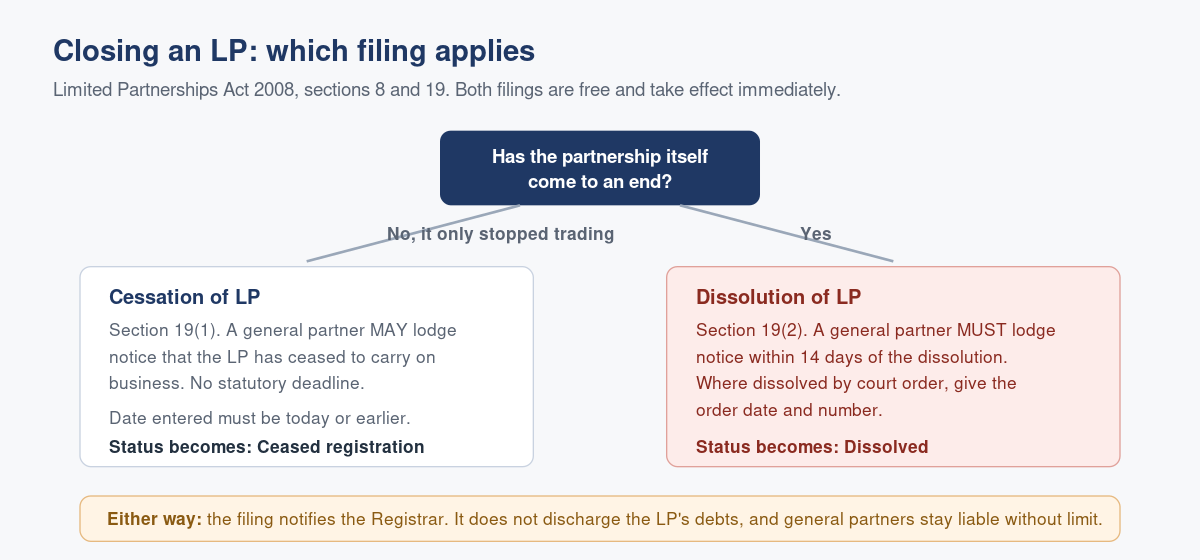
Cessation is about activity. Section 19(1) of the Limited Partnerships Act 2008 allows a general partner of an LP that has ceased to carry on business to lodge a notice with the Registrar saying so. Note the word: may. Cessation is a power, not a duty.
Dissolution is about existence. Where an LP has been dissolved, section 19(2) requires a general partner to lodge notice with the Registrar within 14 days of the dissolution. Note that word too: must. This one is an obligation, and the 14 days run from the dissolution itself, not from the day somebody remembers to deal with the paperwork.
The practical test is simple. Has the partnership simply stopped trading while the partners remain partners? That is cessation. Has the partnership itself come to an end, whether by agreement, by the operation of the partnership deed, by a partner’s death or bankruptcy, by court order or otherwise? That is dissolution, and the clock is already running.
A limited partner cannot end the partnership
Section 8 of the Act deliberately restricts what a limited partner can do to an LP. A limited partner is not entitled to dissolve the partnership by notice. The LP is not dissolved by the death, dissolution, bankruptcy or liquidation of a limited partner. The other partners cannot dissolve it merely because a limited partner’s share has been charged for that partner’s separate debt. Mental incapacity of a limited partner is not by itself a ground for the court to dissolve the partnership, unless that person’s share cannot otherwise be ascertained and realised.
All of that is subject to any express or implied agreement between the partners, so the partnership deed can change the position. But the default is that the passive money does not get to switch the lights off.
And when a dissolution does happen, section 8 puts the work where you would expect it: the affairs of the LP are wound up by the general partners, unless the court orders otherwise. There is no liquidator and no appointment to file. The general partners simply have to do it.
The comparison that matters
| Cessation of LP | Dissolution of LP | |
|---|---|---|
| What it records | The LP has stopped carrying on business | The LP has come to an end |
| Statutory basis | Section 19(1), Limited Partnerships Act 2008 | Section 19(2), Limited Partnerships Act 2008 |
| Mandatory? | No. A general partner may lodge | Yes. A general partner must lodge |
| Deadline | None specified | Within 14 days of the dissolution |
| Who may file | General partner, or a registered CSP | General partner, or a registered CSP |
| Date you enter | The cessation date, current or past | The date of dissolution |
| Reason required | Yes, from a list, with free text for other reasons | Yes, including cessation of partnership, a partner’s death or bankruptcy, court order or other reason |
| Court order details | Not applicable | Where dissolution was by court order, the order date and number |
| Fee | Free | Free |
| Processing | Immediate | Immediate |
| Resulting status | Ceased registration | Dissolved |
Before you file: the things that outlive the LP
The registry filing takes a few minutes. The clean-up does not, and it should happen first.
- Finish or assign the contracts. An LP that has ceased registration can still be sued on a contract it entered into. Running contracts need to be completed, terminated or novated before the partners scatter.
- Cancel GST registration with IRAS, if the LP is registered. This is a separate process with IRAS/gst-registration-deregistration/cancelling-gst-registration) and closing the LP on Bizfile does not do it for you.
- Deal with assets held in the LP’s name. Vehicles, equipment, leases and anything else with a registration or a title need to be transferred while there is still somebody obviously entitled to sign.
- Clear outstanding loans, grants and facilities. Grants in particular often carry conditions that survive, and some require notification if the recipient stops operating.
- Settle employee and statutory obligations. Final salaries, CPF and any pass holders are not the Registrar’s business, but they are still yours.
- Check the registration is current. If the LP’s registration has expired, you must renew it before you can file a cessation. This surprises people who assumed an expired registration was a kind of closure. It is not.
That last point is worth sitting with. An LP registration is valid only for the period the Registrar specifies and is renewable, under section 12(4) of the Act. Letting it lapse is not closing the LP. It leaves you with an expired registration you then have to pay to revive before you are allowed to close it properly.
Filing it in Bizfile
Both transactions run through the same File cessation or dissolution of business entity eService on Bizfile. There is no fee and the change takes effect immediately.
- Log in as a Business User through Corppass. If you have not used Bizfile before, our guide to logging in as a business user covers the access step, which is usually the slow part.
- If you are filing as a CSP, select the Corporate Service Provider profile, choose the correct firm if you belong to more than one, and search for the entity.
- Open the cessation or dissolution eService and start the transaction.
- Select the transaction type: cessation of limited partnership, or dissolution of limited partnership. Getting this wrong is not a cosmetic error, because the two produce different registered statuses.
- Enter the date. For a cessation, this must be the current date or a past date, so you cannot file a cessation in advance of stopping. For a dissolution, enter the date of dissolution.
- Select the reason from the dropdown. If you choose the “other reasons” option, describe the reason in the text box. Where the dissolution was by order of court, enter the date of the order and the court order number.
- Review and submit. The status updates to “Ceased registration” or “Dissolved”, and a notification lands in your Bizfile Inbox.
Keep the Inbox notification. It is your evidence of the date and the filing, and it is considerably easier to produce at the time than to reconstruct two years later when a bank or a counterparty asks.
What goes wrong in practice
The 14 days are missed because nobody identified the dissolution date. Partnerships do not always end on a date anybody wrote down. They end when a partner dies, or when the deed says they end, or when the partners agree over a phone call. The section 19(2) obligation still runs from that date. If you are a general partner, pin the date down early, because you cannot lodge within 14 days of a date you have not established.
Cessation is filed when the LP was actually dissolved. They produce different registered statuses, and the register is what third parties rely on. Filing the wrong one creates a mismatch between the register and the legal reality that has to be corrected later.
Somebody treats the filing as a discharge of liability. It is not. An LP is a partnership, general partners are liable without limit for the firm’s obligations, and no Bizfile transaction changes that. Creditors of the LP retain their claims against the general partners after the register says “Ceased registration”.
The reason entered does not match the facts. Providing information to the Registrar that is false in a material particular, where you know or have reason to believe it is false, is an offence under section 33 of the Limited Partnerships Act 2008, carrying on conviction a fine of up to $5,000, imprisonment of up to 12 months, or both. The free text box is not the place to be approximate.
The partners walk away and let the Registrar close it. Where the Registrar has reasonable cause to believe an LP is not carrying on business or has been dissolved, section 19 allows the Registrar to write to the LP and all its general partners, and if no answer showing cause to the contrary arrives within one month, to cancel the registration. The cancellation is published in the Gazette. It works, in the sense that the LP eventually leaves the register. It is not a good look on a general partner’s record, and it means the closure happened on the regulator’s timetable and terms rather than yours.
If you are choosing between business structures at the point of closing, or comparing this to the alternatives, our guides on closing a sole proprietorship or partnership and on voluntary winding up versus striking off set out how the company routes differ. The general corporate secretarial steps when closing down apply to an LP too, minus the company-specific filings.
Frequently asked questions
What is the difference between cessation and dissolution of an LP?
Cessation records that the LP has stopped carrying on business, and a general partner may lodge it under section 19(1) of the Limited Partnerships Act 2008. Dissolution records that the partnership has ended, and section 19(2) requires a general partner to lodge notice within 14 days of the dissolution.
How much does it cost to close an LP?
Nothing. Both the cessation and the dissolution filings are free through the Bizfile cessation and dissolution eService, and both take effect immediately. The cost of closing an LP sits in the clean-up beforehand, not in the registry fee.
Can a limited partner close the LP?
No. Only a general partner, or a registered corporate service provider acting for one, can file. Section 8 also prevents a limited partner from dissolving the partnership by notice, and provides that the death, bankruptcy or liquidation of a limited partner does not dissolve the LP, unless the partners have agreed otherwise.
Does closing the LP end the partners’ liability for its debts?
No. A limited partnership has no separate legal personality and the filing is a notification to the Registrar, not a discharge. General partners remain liable without limit for the firm’s obligations. Creditors keep their claims whatever the register says.
My LP’s registration has expired. Can I just leave it?
Not if you want a clean closure. An expired registration is not a cessation, and you must renew the registration before you are allowed to file the cessation. Leaving it also exposes you to the Registrar cancelling the registration on its own initiative and gazetting the cancellation.
Who winds up the LP’s affairs after a dissolution?
The general partners, unless the court orders otherwise. That is section 8(6) of the Limited Partnerships Act 2008. There is no liquidator and no appointment to file, which means the obligation to collect assets, pay creditors and account to the partners falls on the general partners personally.
Closing it properly, the first time
The commonest LP closure we are asked to fix is not a botched filing. It is a partnership that stopped trading four years ago, whose registration lapsed, whose GST registration is still live, and whose general partner has just been asked by a bank why the register says what it says.
Raffles Corporate Services handles LP closures end to end: establishing the correct closure route and date, renewing a lapsed registration where one has to be revived before the cessation can be filed, making the Bizfile lodgement inside the statutory window, and running the surrounding clean-up with IRAS and elsewhere so that nothing survives the partnership by accident. If you have an LP you thought was closed, that is worth a quick check.
You can reach us through Raffles Corporate Services, or read more on Singapore corporate secretarial practice at Singapore Secretary Services.
The Editorial Team, Raffles Corporate Services
Need help with corporate secretarial or compliance matters?
If you would like help with your company's corporate secretarial, governance or compliance requirements, email [email protected] or WhatsApp +65 8501 7133.
Our team can assist with corporate secretarial, accounting and tax matters. Where legal advice is needed, advisers from our associated law firms can assist.