

If your LLP has debts it still has to settle, you wind it up. You do not strike it off. Striking off is for an LLP that has stopped trading and has nothing left to resolve; winding up is the formal process that appoints a liquidator, pays the creditors in order of priority, distributes what is left to the partners and ends with dissolution.
Raffles Corporate Services works with a panel of experienced Singapore law firms who offer cost-effective and efficient legal service and advice. This article is general information only and is not legal advice.
Partners get this wrong more often than company directors do, largely because an LLP feels informal. It is not. The Limited Liability Partnerships Act 2005 gives an LLP separate legal personality, and section 39 applies the whole of the Fifth Schedule to its winding up. That Schedule is, in substance, a full insolvency code: statutory demands, declarations of solvency, creditors’ meetings, liquidators’ accounts and offences for officers.
Below are the three routes, what triggers each, the filings and deadlines, and the fines the Fifth Schedule attaches when they are missed.
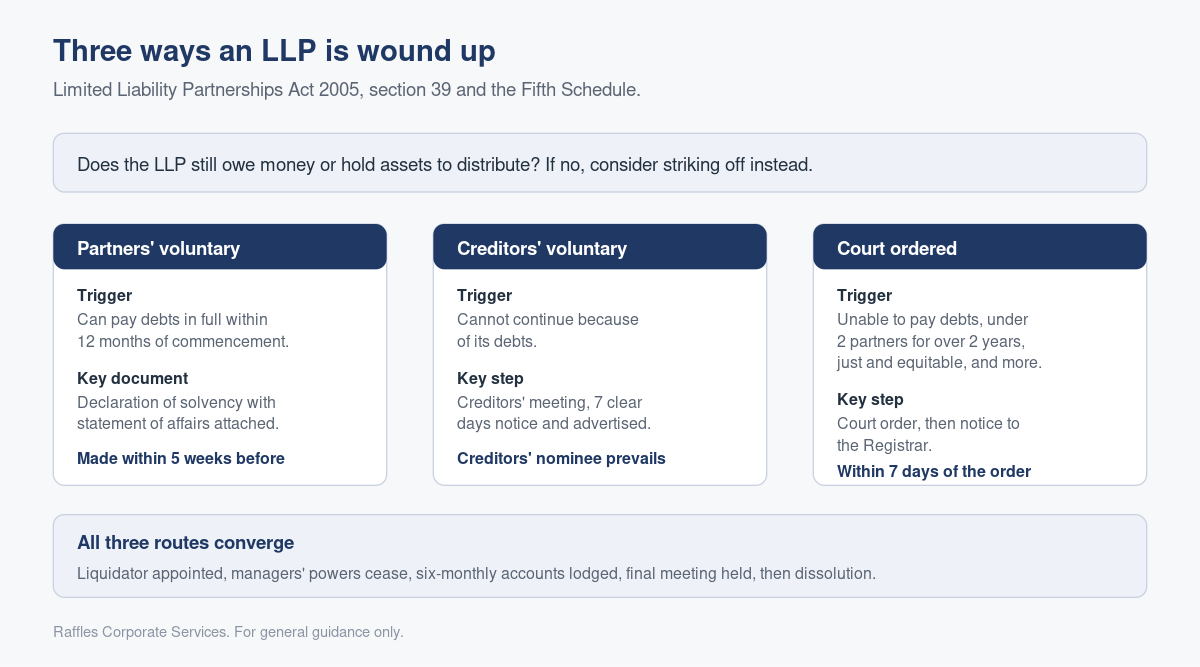
Winding up or striking off: which one applies to you
Start with one question. Does the LLP still owe anyone money, or hold assets that need distributing?
If no, and the LLP has genuinely ceased business, striking off is the cheaper and faster exit: our guide to striking off an LLP in Singapore sets out the eligibility criteria and the objection window, and the closing an LLP overview compares both exits side by side.
If yes, you are in winding up territory, and the route depends on whether the LLP can pay in full.
| Situation | Route | Who starts it |
|---|---|---|
| All partners believe the LLP can pay its debts in full within 12 months | Partners’ (members’) voluntary winding up | The partners, by resolution |
| The LLP cannot continue because of its debts | Creditors’ voluntary winding up | The partners, but the creditors control the liquidator choice |
| The LLP is unable to pay its debts, or another statutory ground applies | Compulsory winding up by the General Division of the High Court | The LLP, a creditor, a partner, the liquidator or the Minister |
Route one: partners’ voluntary winding up
This is the solvent route, and it hinges on a single document.
Under paragraph 40 of the Fifth Schedule, the managers (or a majority of them, where there are more than two) must make a declaration that they have inquired into the affairs of the LLP and formed the opinion that it can pay its debts in full within a period not exceeding 12 months after winding up commences. A statement of affairs showing assets, the amount expected to be realised, liabilities and the estimated winding up expenses must be attached.
Two timing rules decide whether that declaration counts for anything at all:
- It must be made within the five weeks immediately preceding the resolution for voluntary winding up.
- It must be lodged with the Registrar at the same time the resolution is lodged.
Miss either and the declaration has no effect under the Act, which means the winding up is not a solvent one and you are on the wrong track from day one.
The filings that follow
Paragraph 36 requires the LLP to lodge a copy of the winding up resolution with the Registrar within 7 days of passing it, and to advertise the resolution in one or more newspapers circulating in Singapore within 10 days. Contravening that exposes the LLP and every officer in default to a fine of up to $1,000.
The partners then appoint one or more liquidators by resolution under paragraph 41. From that appointment, all powers of control and management held by anyone else cease, except so far as the liquidator approves their continuance. That is a real shift: the managers stop running the LLP on the day the liquidator is appointed, not on the day the last invoice is paid.
If solvency turns out to be wrong
Paragraph 42 puts an unpleasant duty on the liquidator. If at any point the liquidator forms the opinion that the LLP will not be able to pay its debts within the declared period, the liquidator must immediately summon a creditors’ meeting and lay a statement of assets and liabilities before it. The creditors may then appoint someone else, and the winding up proceeds as a creditors’ voluntary winding up. Notice must reach the Registrar and the Official Receiver within 7 days of that meeting.
A manager who made the solvency declaration without reasonable grounds commits an offence carrying a fine of up to $5,000, imprisonment of up to 12 months, or both. Where the debts are not paid within the declared period, paragraph 40 presumes the manager lacked reasonable grounds until the contrary is shown. The burden sits on the manager.
Route two: creditors’ voluntary winding up
Here the partners accept that the LLP cannot carry on because of its debts, and the creditors get the decisive say.
Paragraph 43 requires the LLP to summon a creditors’ meeting for the same day as, or the day after, the meeting at which the winding up resolution is to be proposed. The mechanics are prescriptive:
- Send creditors at least 7 clear days’ notice by post, simultaneously with the notices to partners, enclosing a statement of all creditors’ names and the amounts of their claims.
- Advertise the creditors’ meeting in a newspaper circulating in Singapore at least 7 days before it.
- Lay a full verified statement of the LLP’s affairs before the meeting, showing how assets were valued, with a list of creditors and estimated claims.
- Appoint one manager to attend, who must disclose the affairs of the LLP and the circumstances leading to the winding up.
Contravention here carries a fine of up to $2,000 for the LLP and any officer in default.
The key commercial point is paragraph 44. Both the LLP and the creditors nominate a liquidator, and where they nominate different people, the creditors’ nominee wins. A manager, partner or creditor has 7 days after the creditors’ nomination to apply to court for a different outcome. If you have a preferred insolvency practitioner, that 7-day window is the only lever you have.
Route three: compulsory winding up by the Court
Paragraph 2 lets the LLP itself, any creditor (including a contingent or prospective one), a partner, the Official Assignee or trustee of a bankrupt partner, the liquidator, or the Minister apply for a winding up order.
Paragraph 3 sets out the grounds. The ones that catch ordinary LLPs are a partners’ resolution for a court winding up, carrying on business with fewer than two partners for more than two years, inability to pay debts, the impracticability of carrying on the business in conformity with the LLP agreement, and the just and equitable ground.
“Unable to pay its debts” has a deemed meaning. A creditor owed more than $10,000 then due who serves a written demand at the registered office, and is not paid or secured to the creditor’s reasonable satisfaction within 3 weeks, has established the ground. An unsatisfied enforcement order does the same. So does a failure to lodge the annual declaration required by section 30, until that declaration is lodged. That last limb surprises people: an overlooked annual declaration is itself a gateway to a compulsory winding up application.
Once the order is made, paragraph 9 gives the applicant 7 days to lodge notice of the order, its date, and the liquidator’s name and address with the Registrar, and an office copy with the Official Receiver.
The liquidator’s filing calendar
Once a liquidator is in office, the Fifth Schedule imposes a rhythm of filings. This is where most of the penalty exposure in a long winding up actually sits.
| Filing | Deadline | Fine for default |
|---|---|---|
| Notice of appointment and office address, of any change of address, and of resignation or removal (paragraph 63) | Within 14 days of the event | Up to $1,000 plus $200 per day |
| Account of receipts and payments and statement of position (paragraph 64) | Within one month after each 6-month period from appointment | Up to $1,000 plus $200 per day |
| Annual meeting of partners (and creditors, where applicable) (paragraph 54) | At each year end of the winding up, or within 3 months after | Up to $2,000 plus $200 per day |
| Return of final meeting with account attached (paragraph 55) | Within 7 days of the final meeting | Up to $1,000 plus $200 per day |
One obligation costs nothing and is routinely forgotten: paragraph 66 requires the words “in liquidation” after the LLP’s name where it first appears on every invoice, order for goods and business letter. The fine is modest, but the omission is visible to every counterparty.
How a voluntary winding up actually ends
Paragraph 55 is the finish line. When the affairs are fully wound up, the liquidator prepares an account of how the winding up was conducted and how the property was disposed of, then calls a final meeting to lay that account before it.
The advertising requirement is unusually heavy. The meeting must be advertised at least one month beforehand in at least four local daily newspapers, one each in English, Malay, Chinese and Tamil. There is one relief: if the liquidator files a declaration with the Official Receiver that the LLP has had no trade creditors at or since the commencement of the winding up, a single advertisement in a newspaper circulating generally in Singapore will do.
The liquidator then lodges the return of the meeting, with the account attached, with both the Registrar and the Official Receiver within 7 days. Three months after that lodgment, the LLP is dissolved. The court can defer that date on application. If a quorum (two partners, or two partners and two creditors in a creditors’ voluntary winding up) does not turn up, the liquidator instead lodges a return saying the meeting was duly summoned and no quorum was present, and that counts as compliance.
In a court winding up, dissolution comes instead from a court order, and the liquidator must lodge a copy with the Registrar within 14 days under paragraph 24.
Where to file each document
ACRA splits these filings across two Bizfile eServices, and picking the wrong one is a common hold-up. The Manage winding up eService handles liquidator lifecycle filings: appointment and cessation of a liquidator or provisional liquidator, the account of receipts and payments and statement of position, the return relating to the final meeting, and changes of office address. The General lodgement eService handles the statement of affairs, notice of holding of a creditors’ meeting, and dissolution. ACRA’s winding up guidance for LLPs sets out which items sit where. You will need Corppass access for either; our guide to Bizfile business user login through Corppass covers that first.
What goes wrong in practice
The declaration is made too early. Partners get the accountant to prepare the solvency declaration, then take six weeks to organise the resolution. The five-week window in paragraph 40 has closed and the declaration is worthless. Fix the resolution date first, then work backwards.
Nobody advertises. The 10-day newspaper advertisement after the resolution, and the one-month advertisement before the final meeting, are the two most commonly skipped steps. Both are statutory, both carry fines, and neither is chased by ACRA before the deadline.
The annual declaration is left unfiled while winding up is “being arranged”. Section 30 obligations do not pause because the partners have decided to close. An unlodged declaration is a deemed inability to pay debts, which hands any irritated creditor a ready-made ground for a court application.
Partners assume dissolution is immediate. In a voluntary winding up it happens three months after the final return is lodged. Plan bank account closures, tax matters and record retention around that date, not around the final meeting. Cancel GST registration with IRAS where applicable before the liquidator distributes; IRAS sets out the cancellation process/gst-registration-deregistration/cancelling-gst-registration).
Frequently asked questions
Can an LLP with debts be struck off instead of wound up?
No. Striking off assumes there is nothing left to resolve. If the LLP has creditors, assets to distribute or unresolved obligations, the proper route is winding up, and a strike-off application in those circumstances risks objection and rejection.
Who chooses the liquidator in a creditors’ voluntary winding up?
The creditors. Where the partners and the creditors nominate different people, the creditors’ nominee is the liquidator. A manager, partner or creditor may apply to court within 7 days of the creditors’ nomination for a different result, but that is the only route.
How long after the final meeting is the LLP dissolved?
Three months after the liquidator lodges the return of the final meeting, with the account attached, with the Registrar and the Official Receiver. The court can defer that date on the application of the liquidator or any interested person.
Do the managers stay in charge during a winding up?
No. On the appointment of a liquidator, all powers of control and management held by anyone else cease, subject only to the liquidator’s (or, in a creditors’ winding up, the committee of inspection’s or creditors’) approval of their continuance.
Does a liquidator have to file anything during the winding up, or only at the end?
Throughout. The liquidator lodges notice of appointment within 14 days, an account of receipts and payments and a statement of position within one month after each six-month period, and calls an annual meeting if the winding up runs beyond a year.
Closing an LLP without collecting fines on the way out
Winding up an LLP is not difficult, but it is unforgiving about dates. The declaration window, the 7-day and 10-day resolution filings, the 14-day liquidator notices, the six-monthly accounts and the one-month advertisement before the final meeting are all hard deadlines with fines attached, and none of them generate a reminder.
That calendar is the part we run. Raffles Corporate Services manages the corporate secretarial side of LLP closures alongside the appointed liquidator, keeps the Bizfile filings inside their windows, and makes sure the strike-off or winding up decision is the right one before anything is signed. Read more on Singapore corporate secretarial practice at Singapore Secretary Services.
The Editorial Team, Raffles Corporate Services
Need help with corporate secretarial or compliance matters?
If you would like help with your company's corporate secretarial, governance or compliance requirements, email [email protected] or WhatsApp +65 8501 7133.
Our team can assist with corporate secretarial, accounting and tax matters. Where legal advice is needed, advisers from our associated law firms can assist.