

The court route is the alternative, not the default. Under section 78G of the Companies Act 1967, a company limited by shares may reduce its share capital by special resolution approved by an order of the court, as an alternative to reducing it under section 78B or 78C. You choose it when the out of court route will not work.
Raffles Corporate Services works with a panel of experienced Singapore law firms who offer cost-effective and efficient legal service and advice. This article is general information only and is not legal advice.
That framing matters, because it is not a hierarchy. Section 78G is a parallel road, for the situations in which no set of directors could honestly sign a solvency statement, or in which a creditor is certain to object and the company would rather have the question decided once by the court than have a resolution cancelled six weeks in.
If your company can satisfy the solvency test and no creditor is likely to complain, read the solvency statement route instead. This article is for the harder cases.
When the court route is actually necessary
There is no statutory list, so here is the practical one.
The directors cannot sign the solvency statement. Section 7A of the Companies Act 1967 requires every director to form the opinion that there is no ground on which the company could be found unable to pay its debts, that it will pay its debts as they fall due over the next 12 months, and that assets are not less than liabilities including contingent liabilities, both before and after the reduction. A company with a material unresolved claim or a stressed balance sheet cannot produce that statement honestly. Signing it anyway is not a commercial risk, it is an offence exposure.
A creditor has already said it will object. Under section 78D a creditor has six weeks from the resolution date to apply to have the resolution cancelled. If you know that application is coming, the out of court route buys six weeks of delay followed by contested litigation anyway. Going to court first puts the creditor question before the judge as part of the approval, rather than as an attack on a resolution you have already passed.
The reduction is one limb of a larger court-supervised transaction. Schemes of arrangement and restructurings that already require a hearing often fold the capital reduction into the same process.
Unanimous director sign-off is unobtainable. A board with an absent, uncooperative or resigning director cannot satisfy “every director”. The court route does not require a solvency statement at all.
What the court route looks like
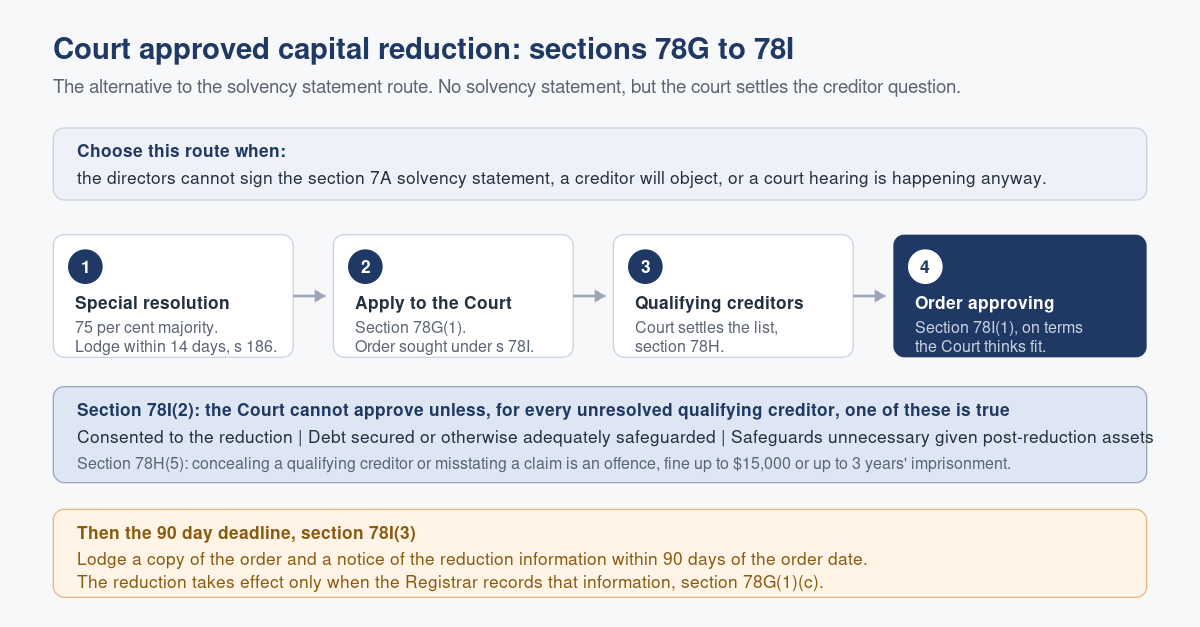
Section 78G(1) requires a special resolution, approved by an order of the court under section 78I. The resolution and the reduction do not take effect until three things have happened: the order has been made, the company has complied with section 78I(3) by lodging the required information with the Registrar, and the Registrar has recorded that information in the appropriate register.
Note the sequencing. You still need the members’ special resolution: a 75 per cent majority, in general meeting or by written means for a private company. The court is not a substitute for shareholder approval, it is an addition to it. The resolution must still be lodged within 14 days, because section 186 applies to every special resolution regardless of route.
Creditor protection: the qualifying creditor list
This is the substantive difference between the two routes, and it is the part that consumes time and legal fees.
Section 78H applies automatically if the proposed reduction involves either a reduction of liability in respect of unpaid share capital, or the payment to a shareholder of any paid-up share capital, and in any other case where the court directs it.
Where it applies, the court settles a list of qualifying creditors: creditors who, at a date fixed by the court, are entitled to any debt or claim that would be admissible in proof against the company if that date were the commencement of a winding up (section 78H(6)). A broad class, including contingent claims.
Section 78H(4) puts the burden of compiling the list on the court rather than on creditors: it must ascertain, as far as possible without requiring an application from any creditor, the names of qualifying creditors and the nature and amount of their debts or claims, and may publish notices fixing days by which creditors not on the list must claim inclusion or be excluded. In practice the company supplies the underlying material, which turns the exercise into a full reconciliation of the creditor ledger.
Section 78H(3) is the relief valve: where the reduction involves unpaid capital liability or a payment of paid-up capital to a shareholder, the court may, having regard to special circumstances, direct that a class or classes of creditors are not qualifying creditors.
Concealing a creditor is a criminal offence with a stated penalty
Section 78H(5) is worth putting in front of any officer tempted to leave an awkward name off a schedule. An officer who intentionally conceals the name of a qualifying creditor, intentionally misrepresents the nature or amount of any creditor’s debt or claim, or aids, abets or is privy to such concealment or misrepresentation, is guilty of an offence and is liable on conviction to a fine not exceeding $15,000 or to imprisonment for a term not exceeding three years.
What the court must be satisfied of before it approves
Section 78I(1) gives the court a broad discretion: it may make an order approving the reduction unconditionally, or on such terms and conditions as it thinks fit.
That discretion is constrained by section 78I(2). If, at the time the court considers the application, there is a qualifying creditor on the court’s list under section 78H whose claim has not been terminated or whose debt has not been discharged, the court must not approve the reduction unless it is satisfied, as respects each such creditor, of one of three things:
- the creditor has consented to the reduction;
- the creditor’s debt or claim has been secured, or the creditor has other adequate safeguards for it; or
- security or other safeguards are unnecessary in view of the assets the company would have after the reduction.
Read that list as a work plan. Consent, security, or headroom. Every unresolved qualifying creditor has to be placed in one of those three boxes before the hearing, or the application stalls. Most of the preparation is spent obtaining lender and landlord consents and quantifying post-reduction net assets to a standard a judge will accept.
The 90 day filing deadline, and what happens if you miss it
Section 78I(3) is the trap at the end. Where the court makes an order approving the reduction, the company must, for the reduction to take effect, lodge with the Registrar a copy of the order and a notice containing the reduction information, within 90 days beginning with the date the order is made. The Registrar may allow a longer period on the application of the company and on payment of the prescribed fee. “Reduction information” is defined in section 78A(4) as the amount of share capital reduced and the number of shares cancelled.
Ninety days sounds generous. It is not: the drafting of the order, the extraction of a sealed copy and the reconciliation of the exact capital and share figures all happen after the hearing, when everyone feels the matter is finished.
Court route versus solvency statement route, side by side
| Feature | Solvency statement route (s 78B / 78C) | Court approved route (s 78G to 78I) |
|---|---|---|
| Special resolution required | Yes | Yes |
| Solvency statement from every director | Yes, unless the s 78B(2) or 78C(2) exception applies | Not required |
| Court involvement | Only if a creditor objects under s 78D | Built in, an order under s 78I is a precondition |
| Creditor process | Six week objection window, creditors must act | Court settles a list of qualifying creditors (s 78H) |
| Test applied | Directors’ solvency opinion (s 7A) | Each qualifying creditor consented, secured, or safe given post-reduction assets |
| Publicity filing | Yes | Not part of the s 78G route |
| Key deadline | Completion documents after six and before eight weeks from the resolution date | Order and reduction information within 90 days of the order |
| Extension of time available | No | Yes, on application and payment of the prescribed fee |
| Effective date | When the Registrar records the information (s 78E(5)) | Same (s 78G(1)(c)) |
| Typical elapsed time | About two months from the resolution | Longer, driven by the court timetable |
What goes wrong
The company treats the court order as the finish line. Section 78G(1) is explicit that the reduction does not take effect until the order is made, section 78I(3) is complied with, and the Registrar has recorded the information. A company that obtained an order in March and files in August has a reduction that never took effect, and a set of accounts that says otherwise.
The creditor schedule is incomplete. Contingent creditors are the usual omission: intercompany guarantees, unbilled professional fees, disputed claims and warranty obligations. Section 78H(6) reaches all of them. Beyond the section 78H(5) offence, an incomplete schedule means the hearing is adjourned while the list is resettled.
Consents are chased after the hearing date is fixed. Bank consents take weeks. If a lender’s credit committee has to meet, that is a calendar constraint no court timetable will accommodate.
The wrong route was chosen. Companies sometimes go to court out of caution when the reduction involves no distribution of cash or assets and no release of liability owed to the company, meaning sections 78B(2) or 78C(2) would have dispensed with the solvency statement entirely. Test the exception before you brief counsel.
Somebody assumes the court route skips shareholder approval. The special resolution must still be passed and lodged within 14 days under section 186. See our guide to filing the special resolution in Bizfile.
Frequently asked questions
When does a Singapore company have to use the court route to reduce share capital?
There is no case where it is legally compulsory, because section 78G frames it as an alternative. In practice it becomes necessary when the directors cannot honestly sign the section 7A solvency statement, when a creditor is certain to object under section 78D, or when the reduction forms part of a larger transaction already before the court.
Does the court route avoid the need for shareholder approval?
No. Section 78G(1) requires a special resolution, a 75 per cent majority, in addition to the court order, and the resolution must be lodged within 14 days under section 186. The court order approves the reduction; it does not authorise it in place of the members.
Who is a “qualifying creditor”?
Under section 78H(6), a creditor who at a date fixed by the court is entitled to a debt or claim that would be admissible in proof against the company if that date were the commencement of a winding up. That includes contingent claims. The court settles the list itself and may publish notices fixing dates for inclusion.
How long do we have to file the court order with ACRA?
Ninety days beginning with the date the order is made, under section 78I(3), lodging a copy of the order and a notice containing the reduction information. The Registrar may allow a longer period on application and on payment of the prescribed fee, but that is a separate request.
What is the penalty for leaving a creditor off the list?
Under section 78H(5), an officer who intentionally conceals a qualifying creditor’s name, intentionally misrepresents the nature or amount of a creditor’s debt or claim, or aids, abets or is privy to either, is liable on conviction to a fine not exceeding $15,000 or imprisonment for up to three years.
Deciding which road to take
The choice is made before anything is drafted, by asking one question honestly: can every director sign the solvency statement, today, with the contingent liabilities properly counted? If yes, take the out of court route and save the cost. If no, or if it is a reluctant maybe, the court route is cheaper than an offence.
Raffles Corporate Services advises on which route fits, prepares the creditor reconciliation and consent pack that court applications live or die on, and handles the post-order filings inside the 90 day window, working alongside your litigation counsel on the hearing itself.
Read the other half of this pair, the solvency statement route, and the related notes on ordinary versus special resolutions, share capital and reserves and the declaration of solvency in a members’ voluntary liquidation, which tests directors on similar ground. Statutory text on Singapore Statutes Online; ACRA’s overview at acra.gov.sg.
— The Editorial Team, Raffles Corporate Services
Need help with corporate secretarial or compliance matters?
If you would like help with your company's corporate secretarial, governance or compliance requirements, email [email protected] or WhatsApp +65 8501 7133.
Our team can assist with corporate secretarial, accounting and tax matters. Where legal advice is needed, advisers from our associated law firms can assist.