

Once your members have passed the special resolution to reduce share capital, you have 14 days to file it with ACRA. The filing is free, it goes through the Update reduction of share capital eService in Bizfile, and it processes immediately. It is also only the first of up to three filings the reduction will need.
Raffles Corporate Services works with a panel of experienced Singapore law firms who offer cost-effective and efficient legal service and advice. This article is general information only and is not legal advice.
This article is about the mechanics: who can file, what to have in hand before you open the transaction, what the 14 day clock actually runs from, and what comes next. It deliberately stays out of the substantive law. If you have not yet decided which route your reduction takes, read the solvency statement route or the court approved route first, because the filings that follow this one differ depending on the answer.
Why this filing exists
Section 186(1) of the Companies Act 1967 requires a copy of every special resolution to be lodged with the Registrar within 14 days after it is passed, unless the Act expressly provides otherwise. A resolution to reduce share capital is a special resolution, so section 186 catches it.
The consequence of not filing is set out in section 186(3): the company and every officer in default is guilty of an offence and is liable on conviction to a fine not exceeding $1,000, and also to a default penalty. A default penalty accrues, which is the point most people miss. It is not a one-off.
Both private and public companies limited by shares file this transaction, and it applies whichever route you have chosen. A company heading for a court order under section 78G still passes a special resolution, and so still lodges it under section 186.
What the 14 days runs from
The resolution date. Section 78A(4) defines “resolution date” as the date when the resolution is passed.
For a resolution passed in general meeting that is the meeting date. For a private company resolution passed by written means under section 184A, it is the date the resolution is taken to be passed under that section, which is not the date the last signature arrives on your desk and is not the date you circulate the pack. Get this date right, because it is the anchor for every later deadline in the reduction: the six week creditor objection window under section 78D, the six to eight week completion filing window under section 78E, and the publicity filing.
Who can submit it
Two options. A position holder of the company, meaning a director, company secretary or other officer with the relevant Bizfile access, can file directly. Or you can appoint a registered corporate service provider to file on the company’s behalf.
If you are filing directly, you need Corppass access to the company with the appropriate eService role assigned. If that has never been set up, do it before the resolution is passed, not in the last three days of the 14. Our notes on logging in to Bizfile as a business user and on assigning Corppass eService roles cover the access problem, which is the most common reason a filing that should take four minutes takes four days.
What to prepare before you open the transaction
| Item | Notes |
|---|---|
| Unique entity number (UEN) | The entity you are filing for. Confirm it on screen before you proceed, especially if you hold positions in more than one company. |
| Date of the special resolution | The resolution date as defined in section 78A(4). This drives every subsequent deadline. |
| Nature of the reduction | Which of the section 78A(1) limbs applies: extinguishing or reducing unpaid liability, cancelling capital lost or unrepresented by assets, or returning surplus paid-up capital. |
| Solvency statement, if any | Required for the section 78B or 78C route unless the section 78B(2) or 78C(2) exception applies. Not applicable to the section 78G court route. |
| Signed copy of the special resolution | Uploaded as part of the transaction. Have it as a clean single file, correctly dated, with the reduction described consistently with what you key in. |
| Fee | None. This filing is free. |
| Processing | Immediate. There is no review queue for this transaction. |
A practical note on the solvency statement. For a public company, section 78C(3)(c) makes lodgment of a copy of the solvency statement, together with the copy of the resolution required under section 186, within 15 days beginning with the resolution date, a condition of meeting the solvency requirements. That is not merely an administrative step. A public company that files the resolution on day 12 and the solvency statement on day 20 has not met the solvency requirements, and the reduction cannot proceed on that resolution.
For a private company, section 78E(1)(d)(i) puts the solvency statement into the later completion filing, after six weeks and before eight weeks from the resolution date, rather than into this one.
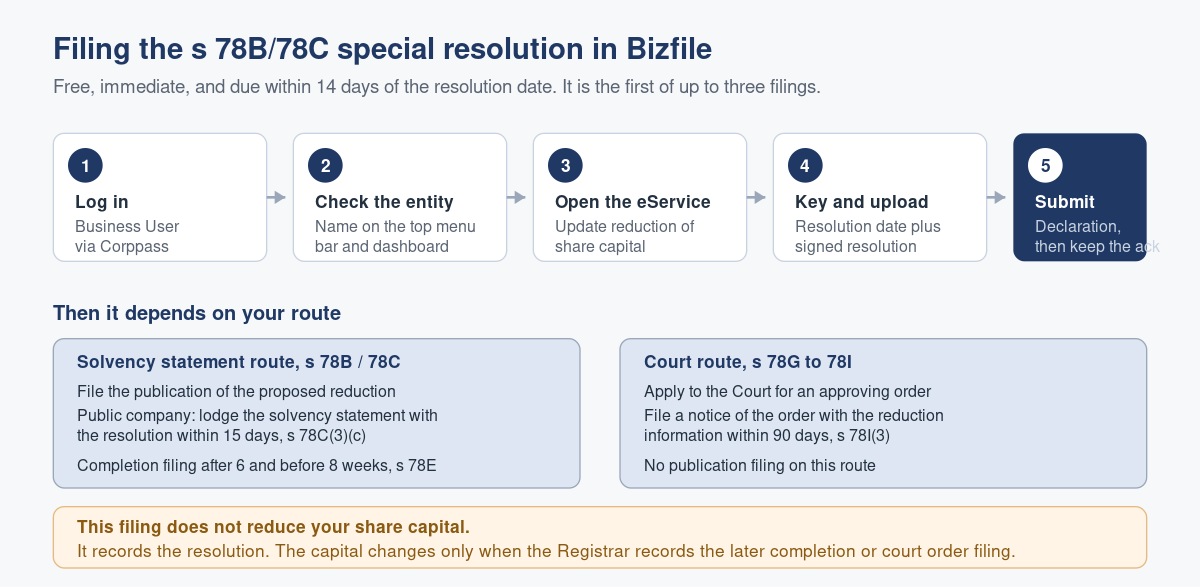
The filing, step by step
- Log in to Bizfile. Select the business user login and authenticate through Corppass.
- Confirm the entity. The entity name shows on the top menu bar and on the dashboard. Check it. Filing a capital reduction against the wrong company in a group is a mistake that needs a Notice of Error at best and a court order at worst.
- If you are filing as a corporate service provider, switch to the corporate service provider profile on the profile selection page, and pick the correct firm if you are attached to more than one.
- Open the Update reduction of share capital eService and start a new transaction.
- Select the transaction type. Choose the option for filing a special resolution for reduction of share capital under sections 78B and 78C. There are several transactions inside this eService, including the publication, the section 78E completion filing, the creditor application notices and the court order filings. Picking the wrong one is the most common misstep here.
- Verify the entity details shown on the confirmation screen.
- Enter the resolution date and upload the signed special resolution. Then move to review.
- Review, tick the declaration, submit. The declaration is a statement of truth. Read the screen rather than clicking through it.
- Keep the acknowledgement. You will see an on-screen acknowledgement and receive a Bizfile notification confirming submission. Save both to the company’s corporate file. They are your evidence of the date of filing if the 14 day compliance is ever questioned.
What you still have to file after this
This is where companies get into trouble: they file the special resolution, breathe out, and assume the reduction is done. The resolution filing changes nothing about the company’s issued share capital.
If you are on the solvency statement route, two more filings follow. First, the publication of the proposed reduction, the publicity requirement that sections 78B(1)(c) and 78C(1)(c) leave to be prescribed by the Minister. ACRA runs it as a separate Bizfile transaction and publishes the resulting notices in fortnightly lists on its website.
Second, the completion filing under section 78E: for a private company, lodging after the end of six weeks and before the end of eight weeks from the resolution date a copy of the solvency statement if applicable, a directors’ statement confirming the publicity and solvency requirements were met and that no cancellation application was made, and a notice containing the reduction information.
If you are on the court route, you file a notice of the court order approving the reduction, with the reduction information, within 90 days of the order date under section 78I(3). The Registrar may allow a longer period on application and on payment of the prescribed fee.
If a creditor objects, there are further filings: a notice of the creditor’s application to court under section 78D, and if the court cancels the resolution, a notice of that order. Section 78F(4) requires the company to send notice of a cancellation order to the Registrar within 15 days of the date the order is made.
What goes wrong
Wrong resolution date keyed in. Everything downstream is calculated from the resolution date. A date that is a week out produces a completion filing that falls outside the six to eight week window under section 78E, and the reduction then does not take effect. Correcting it means a Notice of Error, and if that will not resolve it, an order of court to amend the register.
Filed against the wrong entity. Group structures with similar names and a single Corppass administrator produce this regularly. The entity name is on the top menu bar and the verification screen for a reason.
Wrong transaction selected inside the eService. The publication, the resolution filing and the section 78E completion filing are separate transactions with separate deadlines. Filing the resolution twice and never filing the publication is a real pattern.
Public company files the solvency statement late. Section 78C(3)(c) makes 15 day lodgment a condition of meeting the solvency requirements, so the consequence here is substantive rather than administrative.
Nobody is watching the 14 day clock over a holiday. The section 186(3) penalty includes a default penalty that continues to accrue, and a late filing on a share transaction is the kind of thing a due diligence exercise notices.
The uploaded resolution does not match the keyed data. If the document describes a different amount, or is dated differently, you have created a discrepancy on the public file that somebody will eventually ask about.
Frequently asked questions
How long do I have to file a share capital reduction special resolution with ACRA?
Fourteen days from the resolution date. Section 186(1) of the Companies Act 1967 requires a copy of every special resolution to be lodged within 14 days after it is passed. Under section 186(3), default makes the company and every officer in default liable on conviction to a fine not exceeding $1,000, and also to a default penalty.
Is there a fee for this Bizfile filing?
No. Filing the special resolution for reduction of share capital under sections 78B and 78C is free, and it processes immediately on submission. Later filings in the reduction are separate transactions; an application to the Registrar for extra time to file a court order under section 78I(3) does attract a prescribed fee.
Does filing the special resolution reduce my company’s share capital?
No. It records the resolution. On the out of court route the reduction takes effect only when the Registrar records the information lodged in the completion filing under section 78E, per section 78E(5). On the court route, only when the Registrar records the information lodged under section 78I(3), per section 78G(1)(c).
Do public companies file anything extra at this stage?
Yes. Under section 78C(3)(c), a public company must lodge a copy of the solvency statement together with the copy of the resolution required under section 186, within 15 days beginning with the resolution date. That lodgment is a condition of meeting the solvency requirements, not an optional extra.
What if I make a mistake on the filing?
Try a Notice of Error first. If the error cannot be corrected that way, you may need an order of court to amend the record, which is slow and expensive relative to the two minutes it takes to check the entity name and resolution date before submitting.
The filing is the easy part
A capital reduction is a sequence of dated obligations, and this filing is the first. The failures we see are almost never failures of understanding. They are failures of diary: the resolution date recorded wrongly, the publication never filed, the six to eight week window missed while somebody was away.
Raffles Corporate Services runs capital reductions as a controlled sequence, with the resolution date fixed first and every downstream deadline calendared off it before the members even sign. If you are part way through one and unsure which filings are outstanding, send us the resolution date.
Further reading: the solvency statement route, the court approved route, what Bizfile actually is and ordinary versus special resolutions. ACRA’s guide is at acra.gov.sg; statutory text on Singapore Statutes Online.
— The Editorial Team, Raffles Corporate Services
Need help with corporate secretarial or compliance matters?
If you would like help with your company's corporate secretarial, governance or compliance requirements, email [email protected] or WhatsApp +65 8501 7133.
Our team can assist with corporate secretarial, accounting and tax matters. Where legal advice is needed, advisers from our associated law firms can assist.