

A compliant Singapore private company that files everything on time pays ACRA very little: a one-off name application and registration fee to come into existence, and an annual return fee every year after that. Everything else on the fee schedule is a charge for doing something unusual, something optional, or something late.
Raffles Corporate Services works with a panel of experienced Singapore law firms who offer cost-effective and efficient legal service and advice. This article is general information only and is not legal advice.
That is the single most useful way to read ACRA’s fee page. It is not a price list for running a company. It is a price list for events, and most companies never trigger most of them.
Below is how the schedule is structured, what each charge is actually buying, and where the costs that surprise people come from.
How the fee schedule is built
ACRA’s company fees fall into three groups, and knowing which group a charge belongs to tells you whether you can avoid it.
Setup fees. Paid once, at the point the company comes into existence. Unavoidable if you want a company.
Recurring filing fees. Paid every year for as long as the company exists. Predictable, budgetable, and fixed regardless of the company’s size or turnover.
Event fees. Paid only when something specific happens: you restructure, you need more time, you register security, or you have to correct an earlier filing. This is where the variation lives, and it is the group most worth managing.
All figures below are in Singapore dollars and cover the key company transactions. Specialist filings outside the main company track are priced separately.
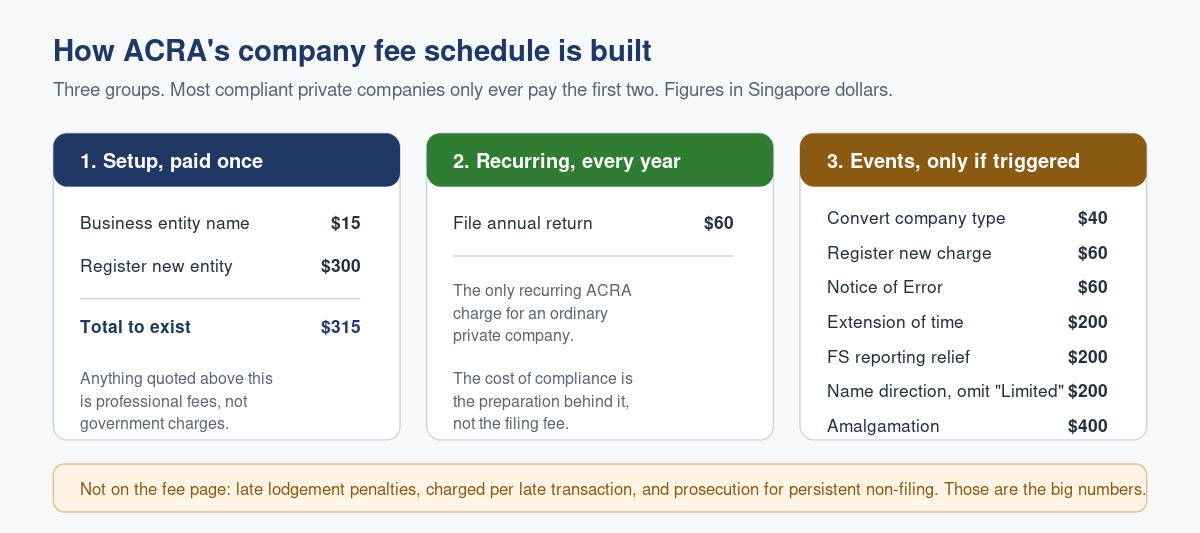
Setting up: what it costs to exist
You cannot register a company without first reserving the name, so these two are almost always paid together.
| eService | Fee |
|---|---|
| Apply for a new business entity name | $15 |
| Register a new business entity | $300 |
That is $315 to ACRA for a standard incorporation. Anything you are quoted above that figure is professional fees, a registered office, a nominee director or a corporate secretary, not government charges. It is worth knowing the split, because a quote that bundles everything into one number is impossible to compare against another.
A name application is not a formality. Names get rejected for being identical to an existing entity, for being undesirable, or for touching a controlled word that needs referral to another authority. A rejected application is a lost fee, so the sensible move is to check availability properly before paying.
The annual cost of staying compliant
Every Singapore company must file an annual return with ACRA. Section 197 of the Companies Act 1967 imposes that obligation, and Section 175 separately requires most companies to hold an annual general meeting, subject to the exemptions and dispensations available to private companies.
| eService | Fee |
|---|---|
| File annual return | $60 |
That is the entire recurring ACRA charge for an ordinary private company. Sixty dollars a year.
The reason compliance feels expensive is not the filing fee. It is everything that has to be true before you can file: accounts prepared, financial statements approved, figures tagged where XBRL applies, and the register position accurate. The $60 is the last two minutes of a much longer process.
When you need more time, or a relief
These are the charges that appear when the annual cycle does not go to plan.
| eService | Fee |
|---|---|
| Apply for an extension of time to file accounts, or to hold an AGM | $200 |
| Apply for exemption from financial statement requirements | $200 |
| Waiver to lodge annual filing, foreign companies | $200 |
| Alternative financial statement formats, foreign companies | $200 |
Note the ratio. An extension of time costs more than three times the annual return itself. An extension is not a penalty, and applying for one in good time is far better than filing late, but the pricing makes a point worth absorbing: ACRA charges for the administrative work of considering your request, and that work costs more than the routine filing it postpones.
An extension application also has to be made and decided before the deadline passes. It is not a retrospective fix. Companies that apply in the last week are asking for a decision they may not get in time.
Company changes: the event fees
| Transaction | Fee |
|---|---|
| Convert company type, via general lodgement | $40 |
| Register for amalgamation of business entities, via general lodgement | $400, plus a separate $300 registration fee where the amalgamated company is a new company |
| File a Notice of Error, via general lodgement | $60 |
| Register a new charge | $60 |
| Omission of the word “Limited” or “Berhad” from a company name, or ACRA directing a name change | $200 |
Three of these deserve comment.
Registering a charge, $60. Cheap, and the cheapness is misleading, because registration of a charge is time-critical. A charge that is not registered within the statutory window can be void against a liquidator and against other creditors, which turns a secured lender into an unsecured one. Nobody has ever regretted paying this fee early.
Notice of Error, $60. This is the correction mechanism for a filing that went in wrong. It is inexpensive, but it is not a free undo: it costs money, it takes time, and in the interval the public record shows something incorrect about your company. Getting the original filing right is materially cheaper than correcting it.
Amalgamation, $400 and up. The largest single item on the list, reflecting that an amalgamation is a substantive corporate event rather than an administrative filing. If the amalgamated entity is a new company, the $300 registration fee applies on top.
What is not on the fee page, and costs more than what is
The fee schedule covers transactions. It does not cover consequences. The largest ACRA-related numbers a company is likely to encounter sit outside it entirely.
Late lodgement penalties. These attach to filings made after their statutory deadline and are charged per late transaction, not per company. A company that lets several changes drift can accumulate a bill that dwarfs the underlying fees. ACRA publishes the current scale on its late lodgement penalties page.
Prosecution and composition. Persistent non-filing is an offence, not merely a late payment. Directors, not just companies, are exposed.
Information products. Business profiles, certified extracts, and documents purchased after a free window has closed are all priced separately. The 30-day free window for your constitution and filing extracts is covered in our guide to downloading your free constitution and extracts from Bizfile, and the limits of what a free register download actually proves are set out in what an ACRA register extract proves and what it does not.
Where the money actually leaks
Paying $200 for time you did not need. Extensions are applied for far more often than they are necessary. The usual cause is that nobody started the accounts until the deadline was visible. The fee is the smallest part of the cost.
Correcting filings instead of checking them. A Notice of Error is $60 and a day of somebody’s attention. Reading the draft filing before submitting it is free.
Losing a name application fee. $15 is trivial once. It stops being trivial when a founder burns through five attempts because nobody checked the name against existing entities or controlled words first.
Re-buying documents that were free. The constitution and filing extracts are free to the filer for 30 days and chargeable afterwards. Companies that never collected their own pack buy it back later, sometimes several times over across different advisers.
Treating the annual return fee as the budget. Sixty dollars is the government charge. The real annual cost of compliance is the preparation work behind it, and a company that budgets only for the fee will be surprised every year.
Frequently asked questions
How much does it cost to register a company with ACRA?
$15 to apply for the business entity name and $300 to register the entity, so $315 in government fees for a standard local company. Anything beyond that in a quotation is professional or service fees, such as corporate secretarial work, a registered office address or nominee services, and should be itemised separately.
How much is the ACRA annual return fee?
$60 per filing for a company. That is the only recurring ACRA charge an ordinary private company pays. It does not include the cost of preparing financial statements or of any extension application, and it does not protect you from late lodgement penalties if the return is filed after its deadline.
Is it cheaper to apply for an extension than to file late?
They are different things, not alternatives. An extension of time costs $200 and must be applied for and granted before the deadline. Filing late attracts a late lodgement penalty on ACRA’s published scale, charged per late transaction. Applying in good time is the controllable option; filing late is not.
Do I have to pay to correct a mistake in a filing?
Yes. A Notice of Error is filed through the general lodgement route and costs $60. It is the formal mechanism for correcting information already on the register. Until it is processed, the public record continues to show the incorrect particulars, which is the real cost rather than the fee.
Why does registering a charge only cost $60 when the stakes are so high?
Because the fee reflects the administrative cost of the filing, not the commercial value of the security. Registration is nonetheless time-critical: a charge registered outside the statutory window risks being unenforceable against a liquidator and other creditors, so lenders and borrowers alike should treat the deadline as the point, not the price.
Are these fees subject to change?
Yes. ACRA revises its fee schedule from time to time and publishes the current figures on its own fees page with a last-updated date. Before you commit to a budget or quote a client, check the live page rather than relying on any secondary source, including this one.
Budgeting for this properly
The honest summary is that ACRA is not expensive. A well-run Singapore private company pays $315 once and $60 a year, and never sees the rest of the schedule.
Companies that end up paying the rest of the schedule are usually not making expensive choices. They are making late ones: an extension because the accounts slipped, a Notice of Error because a filing was rushed, a repurchase because nobody saved the documents while they were free.
Raffles Corporate Services runs the annual compliance calendar for several hundred Singapore companies, files inside the statutory windows, and keeps the document pack complete so nothing has to be bought back later. If you want a clean view of what your company will actually pay ACRA over the next twelve months, that is a short conversation.
More on Singapore corporate secretarial practice at Singapore Secretary Services. The governing statute is at sso.agc.gov.sg, and ACRA’s own current fee page is at acra.gov.sg.
— The Editorial Team, Raffles Corporate Services
Need help with corporate secretarial or compliance matters?
If you would like help with your company's corporate secretarial, governance or compliance requirements, email [email protected] or WhatsApp +65 8501 7133.
Our team can assist with corporate secretarial, accounting and tax matters. Where legal advice is needed, advisers from our associated law firms can assist.