

A Singapore sole proprietorship or partnership costs $115 in ACRA fees to bring into existence: $15 to apply for the business name and $100 to register the entity. After that the only recurring government charge is a renewal fee of $30 when your registration term runs out.
Raffles Corporate Services works with a panel of experienced Singapore law firms who offer cost-effective and efficient legal service and advice. This article is general information only and is not legal advice.
That is a genuinely small number, and it is why this structure stays popular with people testing an idea. It is also why the structure catches people out. So little money changes hands that nobody builds a routine around it, and the one date that matters gets missed.
Here is the whole schedule, what each charge is buying, and where the real cost of a registered business sits.
The shape of the schedule, not just the numbers
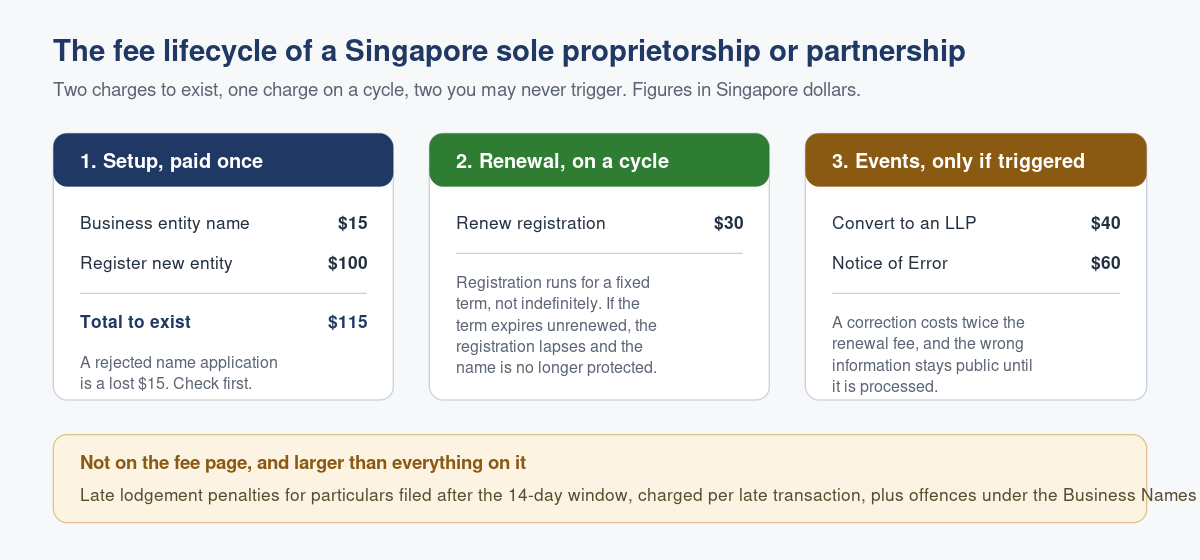
ACRA’s fee page for sole proprietorships and partnerships is short, and its shortness is informative. There are only two things you can be charged for at setup and three things you are likely to be charged for afterwards.
Read the schedule as three groups:
Setup, paid once. A name application, then the registration itself. You cannot do the second without the first, so they are effectively one bill.
Renewal, paid on a cycle. Registration under the Business Names Registration Act 2014 is granted for a fixed term rather than indefinitely. When the term expires you renew and pay again. This is the structural difference from a company, and it is the single most important thing on the page.
Events, paid only if triggered. Converting the business to a limited liability partnership, or correcting a filing that went in wrong. Most registered businesses never touch either.
If the figures change at the next revision, the groups will not. A structure that must be renewed will always carry a renewal fee, and a correction will always cost more than getting it right first time.
What it costs to register
| eService | Fee |
|---|---|
| Apply for a new business entity name | $15 |
| Register a new business entity | $100 |
| Total to come into existence | $115 |
Two points worth absorbing.
First, the $15 name application is not a formality and it is not refundable if the name fails. Business names get rejected for being identical to an existing registered name, for being considered undesirable, or for containing a word that has to be referred to another authority before it can be used. Each attempt costs $15. Founders who pick a name emotionally rather than checking it first sometimes pay four or five times for the privilege.
Second, $115 is the entire government charge. If you have been quoted more, the balance is professional fees: a registered business address, someone to prepare and lodge the application, or an ongoing service. Nothing wrong with paying for that, but you should be able to see the split. A quote that fuses government and service fees into one figure cannot be compared against anything.
Compared with a private limited company
| Sole proprietorship or partnership | Private limited company | |
|---|---|---|
| Name application | $15 | $15 |
| Registration | $100 | $300 |
| Total at setup | $115 | $315 |
| Recurring government charge | Renewal fee of $30 each term | Annual return fee each year |
| Separate legal personality | No | Yes |
| Owner liability | Unlimited, personal | Limited to shares taken |
The company figures are set out in full in our companion piece on ACRA service and transaction fees for companies. The $200 difference at setup is real but small, and it is almost never the deciding factor. Liability is. A sole proprietorship is not a separate person in law, so the debts of the business are your debts, and no amount of saved registration fee compensates for that if something goes wrong.
Renewal: the charge that decides everything
| eService | Fee |
|---|---|
| Renew business registration | $30 |
Thirty dollars. It is the cheapest thing on any ACRA fee schedule and it does the most damage when it is missed.
Registration under the Business Names Registration Act 2014 has an expiry date. It is not a one-off act that persists until you cancel it. When the term ends, the registration lapses unless it has been renewed, and a lapsed registration means the business is no longer registered. The name is no longer protected. Bank accounts, licences, supplier accounts and government scheme eligibility all sit on top of a registration that has quietly stopped existing.
The term you selected when you registered is shown on your registration and on the renewal reminder ACRA sends. Check it rather than assuming.
What happens if you let it lapse
There is no grace period that makes a lapsed registration retrospectively valid. The options narrow to reinstating or re-registering, and both cost more in time and disruption than the $30 would have. Meanwhile any trading you did while unregistered was trading under an unregistered business name, which is not a position you want to be explaining to a bank or a licensing authority.
The fix is dull: put the expiry date in the same calendar as your tax deadlines, and give it to a person rather than a filing cabinet.
The event fees
| eService | Fee |
|---|---|
| Convert to a limited liability partnership (LLP) | $40 |
| File a Notice of Error, via general lodgement | $60 |
Conversion to an LLP, $40. This is the cheapest structural upgrade in the Singapore system, and the most under-used. A partnership that has grown past two friends splitting a project is carrying unlimited personal liability for every partner’s actions. An LLP gives the partners a separate legal entity and limits that exposure, and the ACRA charge for making the change is $40. The ongoing obligations are different, which is the real consideration rather than the fee: we cover them in the companion guide to ACRA fees for a limited liability partnership.
Notice of Error, $60. This is the formal route to correct information already sitting on the register. Note that it costs twice the renewal fee. A correction is priced above the routine filing it is fixing, in every ACRA schedule, and that pricing is a message: check the draft before you submit it. Until the Notice of Error is processed, the public record continues to show the wrong particulars about your business.
What the fee page does not tell you it will cost
The fee schedule prices transactions. It does not price consequences, and the consequences are larger than the fees.
Late lodgement penalties. A sole proprietorship or partnership must notify ACRA of changes to its particulars within 14 days. Miss that window and a late lodgement penalty attaches, charged per late transaction rather than per business. The current scale and how it is tiered is set out in our guide to ACRA late lodgement penalties and on ACRA’s own late lodgement penalties page.
Offences under the Business Names Registration Act 2014. Carrying on business under an unregistered name, or failing to notify required changes, are not merely chargeable events. They are offences, and the owner is personally exposed because there is no company standing between the business and the individual.
Information products. A Business Profile of your own entity, certified extracts, and documents wanted after a free window has closed are all priced separately. See types of ACRA information products for what each one actually proves.
Where the money actually leaks
Missing the renewal. By a wide margin the most common and most expensive failure. It costs $30 to avoid and considerably more to unwind.
Burning name application fees. $15 an attempt. Check the name properly against existing registered entities and against the list of words that need referral before you pay.
Filing changes late. Change of principal place of business, change of partners, change of the owner’s particulars: all inside 14 days. The penalty is charged per late item, so a business that lets three changes drift pays three times.
Staying a sole proprietorship past the point it makes sense. The saving over a company is about $200 at setup and a small annual difference afterwards. Once the business has employees, a lease or real customer money moving through it, unlimited personal liability is the expensive part of the arrangement, not the fees.
Frequently asked questions
How much does it cost to register a sole proprietorship in Singapore?
$115 in ACRA fees: $15 to apply for the business entity name and $100 to register the entity. That is the complete government charge. Any additional amount in a quotation is professional or service fees, such as a registered address or lodgement work, and should be itemised separately so you can compare it.
How much is it to renew a business registration with ACRA?
$30. Registration under the Business Names Registration Act 2014 runs for a fixed term rather than indefinitely, and lapses if it is not renewed before the term expires. Confirm your own expiry date on your registration or renewal notice, because a lapsed registration means you are trading under an unregistered business name.
Is a sole proprietorship cheaper than a company?
At setup, yes: $115 against $315 for a private limited company. The recurring charges are also modest. But a sole proprietorship has no separate legal personality, so the owner is personally liable for all business debts without limit. For most businesses that carry any real risk, the liability difference outweighs the fee difference entirely.
What does it cost to convert a partnership to an LLP?
$40 to ACRA, filed through the general lodgement route. That buys the partners a separate legal entity with limited liability, which is a substantial change in their personal risk for a very small fee. The LLP then has its own ongoing obligations, including an annual declaration, so budget for the compliance cycle rather than just the conversion.
What happens if I file a change to my business late?
A late lodgement penalty applies. Changes to a registered business’s particulars must be notified to ACRA within 14 days, and the penalty is charged per late transaction, not per business. A business that lets several changes drift accumulates several penalties. Bizfile shows the exact amount payable at the point you file.
Do these ACRA fees change?
Yes. ACRA revises its schedules from time to time and each fee page carries a last-updated date. Before you budget, quote a client, or rely on any figure, open ACRA’s own page and read the current number. That applies to every secondary source, including this one.
Keeping a small registration from becoming an expensive problem
The honest summary: ACRA barely charges a sole proprietorship or partnership anything. $115 to start, $30 a term to stay registered, and two event fees you will probably never trigger.
What costs money is inattention. The renewal date arrives while you are busy, a partner leaves and nobody files it, and twelve months later the registration has lapsed and three penalties sit on the account. That is a diary problem, not a pricing problem.
Raffles Corporate Services keeps the renewal calendar for businesses of every size in Singapore, files particulars changes inside the 14-day window, and will tell you plainly when a sole proprietorship has outgrown the structure. If you are not sure when your registration expires, that is a two-minute check worth making today.
More on Singapore corporate secretarial practice at Singapore Secretary Services. ACRA’s current fee page is at acra.gov.sg, and the legislation is at sso.agc.gov.sg.
— The Editorial Team, Raffles Corporate Services
Need help with corporate secretarial or compliance matters?
If you would like help with your company's corporate secretarial, governance or compliance requirements, email [email protected] or WhatsApp +65 8501 7133.
Our team can assist with corporate secretarial, accounting and tax matters. Where legal advice is needed, advisers from our associated law firms can assist.