

If you provide corporate secretarial services or sit as a nominee director, three things changed on 6 May 2026: a new filing when a director becomes disqualified, a personal duty on the disqualified director to speak up within 14 days, and a fine for breach of directors’ duties that is now four times what it was.
Raffles Corporate Services works with a panel of experienced Singapore law firms who offer cost-effective and efficient legal service and advice. This article is general information only and is not legal advice.
The Act was passed by Parliament on 5 November 2025 and published in the Acts Supplement on 3 December 2025 as Act 24 of 2025. It reaches into seven pieces of ACRA-administered legislation, and most commentary has focused on what it does to companies. Part 1 of this pair covers that ground. This part covers the service provider’s side of the desk, including the provisions that are in the Act but are not yet law, which is where a lot of people are about to get their advice wrong.
What is actually in force, and what is not
The Act commences in phases. The Corporate and Accounting Laws (Amendment) Act 2025 (Commencement) Notification 2026, made on 3 April 2026 and published in the Subsidiary Legislation Supplement on 6 April 2026 as S 199/2026, brought the Act into operation on 6 May 2026 except for a long list of named sections.
Read that notification the right way round. It is drafted as “everything except”, so the default is that a provision is in force, and the exceptions include several of the changes that got the most coverage.
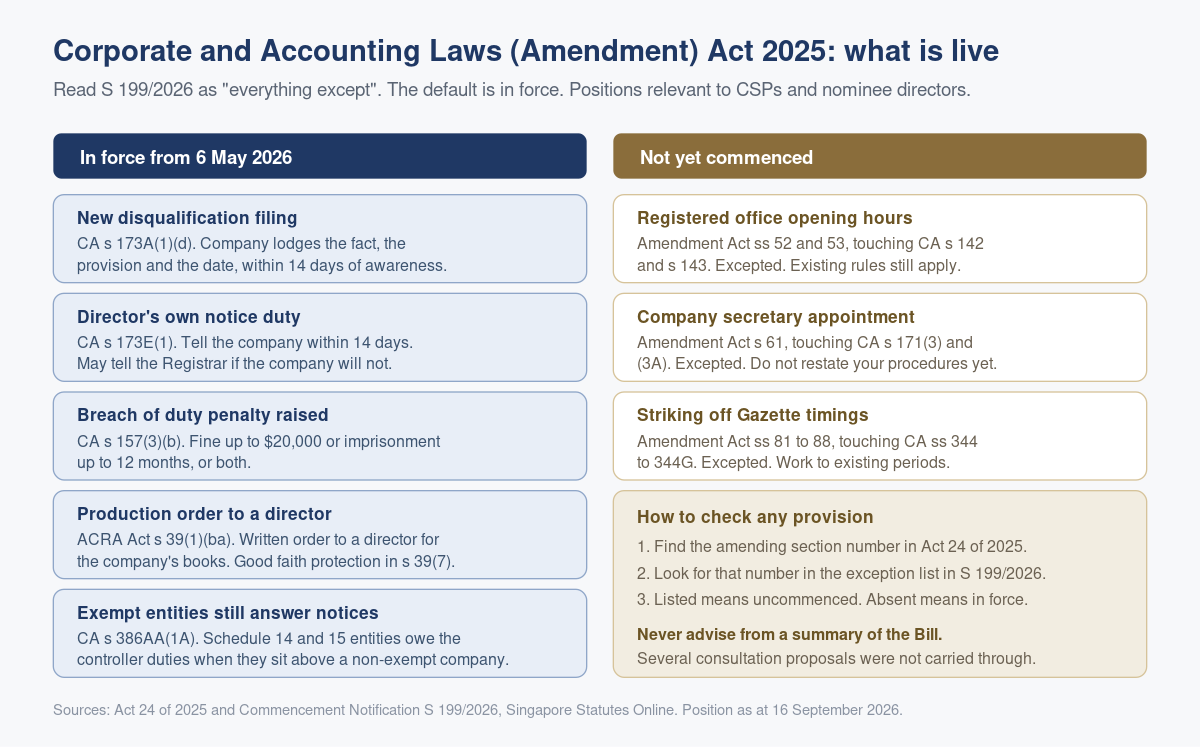
| Change | Provision | Status |
|---|---|---|
| New disqualification ground for money laundering convictions | Section 56, amending section 154(1)(a) of the Companies Act 1967 | In force 6 May 2026 |
| Company must lodge the fact of a director’s disqualification | Section 63, inserting section 173A(1)(d) | In force 6 May 2026 |
| Director must notify the company of his own disqualification | Section 66, replacing section 173E(1) | In force 6 May 2026 |
| Higher penalty for breach of directors’ duties | Section 58, amending section 157(3)(b) | In force 6 May 2026 |
| ACRA may order a director personally to produce company records | Section 2, amending section 39 of the ACRA Act 2004 | In force 6 May 2026 |
| Controller duties bite on exempt entities in the chain | Section 96, inserting section 386AA(1A) | In force 6 May 2026 |
| Registered office three-hour opening requirement removed | Sections 52 and 53 | Not yet commenced |
| Changes to how company secretaries are appointed | Section 61, amending section 171 | Not yet commenced |
| Shorter striking off Gazette timelines | Sections 81 to 88 | Not yet commenced |
The practical instruction is short. Do not change your registered office practice, your secretary appointment paperwork or your striking off timetable yet. Those sections sit in the excepted list and a further notification is needed before they bite.
The new filing: when a director stops being qualified
This is the change that will alter a corporate secretary’s routine, and it is the one fewest people have noticed.
Section 173A of the Companies Act 1967 lists what a company must lodge with the Registrar and by when. A new paragraph (d) requires the company, within 14 days after it becomes aware that a person has ceased to be qualified to act as one of its directors, to lodge three things:
- The fact that the person has ceased to be qualified.
- The provision of the Act under which the person ceased to be qualified, or under which the Court made the disqualification order.
- The date on which the person ceased to be qualified.
The triggering provisions are named: sections 148(1), 154(1), 155(1), 155A(1), 155C(1) and 155D(1) of the Companies Act 1967, plus a disqualification order made by the Court under section 149, 149A or 154(2).
Two things follow. Disqualification is no longer something you discover at annual return time; it is a 14-day filing in its own right. And the clock runs from awareness, not from the disqualifying event, so your file note recording when you were told is the document that decides whether you were late.
The director’s own duty, which is where nominees are exposed
The same amending Act replaced section 173E(1). A director who ceases, on or after the commencement of section 66 of the Amendment Act, to be qualified under any of those provisions must notify the company of the disqualification as soon as practicable, and in any event not later than 14 days after the disqualification.
The subsection also gives that director a right rather than an obligation: he may give the notice to the Registrar himself if he has reasonable cause to believe that the company will not do so.
If you sit as a nominee on a board where you do not control the filings, read that second limb carefully. It exists because the legislature anticipated a company that would rather the disqualification stayed quiet.
The penalty that went up fourfold
Section 157 of the Companies Act 1967 requires a director to act honestly and use reasonable diligence in discharging the duties of his office. Section 58 of the Amendment Act replaced the penalty limb. A person guilty of an offence under section 157 is now liable on conviction to a fine not exceeding $20,000 or to imprisonment for a term not exceeding 12 months, or to both. ACRA has confirmed publicly that the previous maximum fine was $5,000.
Section 157 has no nominee exception. A director who lends a name to a board, does not attend, does not read the accounts and does not ask where the money goes is the paradigm case of failing to use reasonable diligence, and the ceiling on that exposure has just moved. Our note on the sentencing framework the courts now apply to nominee directors covers the criminal end, and shadow director liability covers the person never appointed at all.
Money laundering convictions now disqualify
Section 154(1)(a) of the Companies Act 1967 gained a new sub-paragraph (iii): conviction of an offence under section 50, 51, 53, 54, 55 or 55A of the Corruption, Drug Trafficking and Other Serious Crimes (Confiscation of Benefits) Act 1992 disqualifies a person from acting as a director, where the conviction is on or after the commencement of section 56 of the Amendment Act.
That last clause is a real limitation and worth quoting to clients who assume the change is retrospective. It is not. A conviction before 6 May 2026 does not engage the new ground.
For a corporate service provider the consequence is at onboarding, and we have covered the revised declaration separately in our piece on ACRA’s amended Form 45 and the new money laundering disqualification. Treat the two together: the statute creates the disqualification, the form is where you catch it.
ACRA can now order a director personally to produce company records
This one sits outside the Companies Act and is easy to miss. Section 2 of the Amendment Act rewrote section 39 of the Accounting and Corporate Regulatory Authority Act 2004, adding a new paragraph (ba): in respect of information, books or documents in the possession, knowledge, custody or control of a company, ACRA may issue a written order requiring a director of the company to provide them, by the time and in the form, manner and place specified. A new subsection (1A) extends that to access, inspection and copying without fee, an explanation of the material, and a statement of where it is if it is not produced. A new subsection (7) protects a person who, in good faith and with reasonable care, does or omits to do anything in complying.
Read that from a nominee director’s chair. A written order can now land on you personally, demanding the company’s records, whether or not you hold them. If your nominee engagement does not give you a contractual right to obtain the company’s books on demand, it is now inadequate.
The controller register gap that quietly closed
Section 96 of the Amendment Act inserted a new subsection (1A) into section 386AA of the Companies Act 1967. Its effect: sections 386AG(6), 386AH(6), 386AI(6), 386AIA(3), 386AJ and 386AK apply to a person who is, or who there are reasonable grounds to believe is, a registrable controller of a non-exempt company or foreign company, whether or not that person is itself an entity listed in the Fourteenth or Fifteenth Schedule.
Those are the duty-to-respond limbs. Before the amendment, a service provider with an exempt entity in the ownership chain could be met with the argument that the exempt entity owed nothing when a subsidiary served a controller notice on it. That argument is now closed off. For the mechanics, see who counts as a registrable controller and the five RORC notices.
What goes wrong in practice
Advising on a provision that has not commenced. The single largest risk in the first year of this Act. Somebody reads a summary of the Bill, tells a client the registered office opening hours rule is gone, and the client stands down an arrangement that is still legally required. Check the provision against S 199/2026 before you advise.
Missing the 14-day disqualification filing. It is a new lodgement with no reminder attached to it. The realistic failure is a director disqualified in March and a company that files in November when somebody notices during the annual return.
Assuming the money laundering ground is retrospective. It is not. Getting this wrong in either direction is damaging: refusing a lawful appointment, or accepting one on the basis that a conviction “does not count” when it post-dates commencement.
A nominee engagement letter written before May 2026. If it does not deal with access to the company’s books, indemnity for the cost of responding to a regulatory order, and an obligation on the company to tell you of anything that might disqualify you, it is behind the statute. Review it alongside your CSP compliance obligations under the Corporate Service Providers Act 2024.
Frequently asked questions
When did the Corporate and Accounting Laws (Amendment) Act 2025 take effect?
The Act was passed on 5 November 2025 and commences in phases. Under S 199/2026, the whole Act came into operation on 6 May 2026 except for a list of named sections, which remain uncommenced pending a further notification. Provisions on registered office hours, company secretary appointment and striking off timelines are in that excepted list.
Does a nominee director have to tell the company if he is disqualified?
Yes. Section 173E(1) of the Companies Act 1967 requires a director who ceases to be qualified on or after commencement to notify the company as soon as practicable and not later than 14 days after the disqualification. He may also notify the Registrar directly if he has reasonable cause to believe the company will not.
What is the maximum penalty for breach of directors’ duties now?
A fine not exceeding $20,000 or imprisonment for a term not exceeding 12 months, or both, under section 157(3)(b) of the Companies Act 1967 as amended. ACRA has stated the previous maximum fine was $5,000. The duty itself, to act honestly and use reasonable diligence, has not changed.
Can ACRA demand records from me personally as a director?
Yes, since 6 May 2026. Section 39(1)(ba) of the Accounting and Corporate Regulatory Authority Act 2004 allows ACRA to issue a written order requiring a director to provide information, books or documents held by the company. A person who complies in good faith and with reasonable care is protected from liability under section 39(7).
Do the striking off timeline changes apply yet?
No. Sections 81 to 88 of the Amendment Act, carrying the changes to sections 344 to 344G of the Companies Act 1967, are in the excepted list in S 199/2026 and have not commenced. Work to the existing Gazette periods until a further commencement notification is published.
Where this lands
An amendment Act of this size does not change what a good corporate secretary does. It changes the number of places where doing it late is an offence, and it moves more of the exposure onto named individuals rather than onto the company.
If you hold nominee appointments, the two jobs this quarter are a review of your engagement letters and a working list of the disqualification triggers in sections 148, 149, 149A, 154, 155, 155A, 155C and 155D, so that the 14-day clocks are recognised when they start.
Raffles Corporate Services maintains statutory registers and files officer changes for several hundred Singapore companies. You can read more on Singapore corporate secretarial practice at Singapore Secretary Services, and the Act is on Singapore Statutes Online alongside ACRA’s own amendment Act page.
— The Editorial Team, Raffles Corporate Services
Need help with accounting or bookkeeping?
If you would like accounting, bookkeeping or financial reporting support for your business, email [email protected] or WhatsApp +65 8501 7133.
Our accounting and tax advisers can assist. Where legal advice is needed, advisers from our associated law firms can also assist.