

ACRA’s guidance on the registers of controllers, nominee directors and nominee shareholders is not law. It is the Registrar’s published view of how Part 11A of the Companies Act 1967 works, and it is the document an officer will hold in one hand while inspecting your register with the other. That makes it the most useful thing you can read after the statute itself.
Raffles Corporate Services works with a panel of experienced Singapore law firms who offer cost-effective and efficient legal service and advice. This article is general information only and is not legal advice.
There are seven guidance documents, not one. Most moved to version 2.0 on 16 June 2025, the date a batch of amendments to Part 11A and to the underlying Regulations took effect.
The mechanics of these registers are covered elsewhere in this series. What follows is the layer above them: what the guidance settles that the statute leaves open, and how to resolve the hard cases.
What legal weight does the guidance actually carry?
None directly. ACRA states plainly that the guidance is not exhaustive and does not constitute legal advice, and you cannot plead it as a defence to a charge under Part 11A. What it carries instead is practical weight. Where the guidance sets a minimum for something the statute expresses as an open-ended test, that minimum becomes the floor an inspecting officer measures you against: section 386AG of the Companies Act 1967 requires reasonable steps to identify your registrable controllers and says nothing about how, and the guidance fills that in. The version history is a compliance document in its own right, because the changes are almost always responses to something companies were getting wrong.
The seven documents, and which one you need
| Entity | Controllers | Nominee directors | Nominee shareholders |
|---|---|---|---|
| Singapore company | Guidance for companies, v2.0 | Guidance for companies, v2.0 | Guidance for companies, v2.0 |
| Foreign company registered in Singapore | Guidance for foreign companies, v2.0 | Guidance for foreign companies, v1 | Guidance for foreign companies, v2.0 |
| Limited liability partnership | Guidance for LLPs, v2.0 | Not applicable | Not applicable |
The nominee director guidance for foreign companies was issued as a first version on 16 June 2025, which matters if you act for a branch: before then there was no dedicated guidance for that register at all. Pick the document that matches the entity, not the register; the controller guidance for LLPs is not interchangeable with the version for companies.
Hard case one: how much searching is “reasonable steps”?
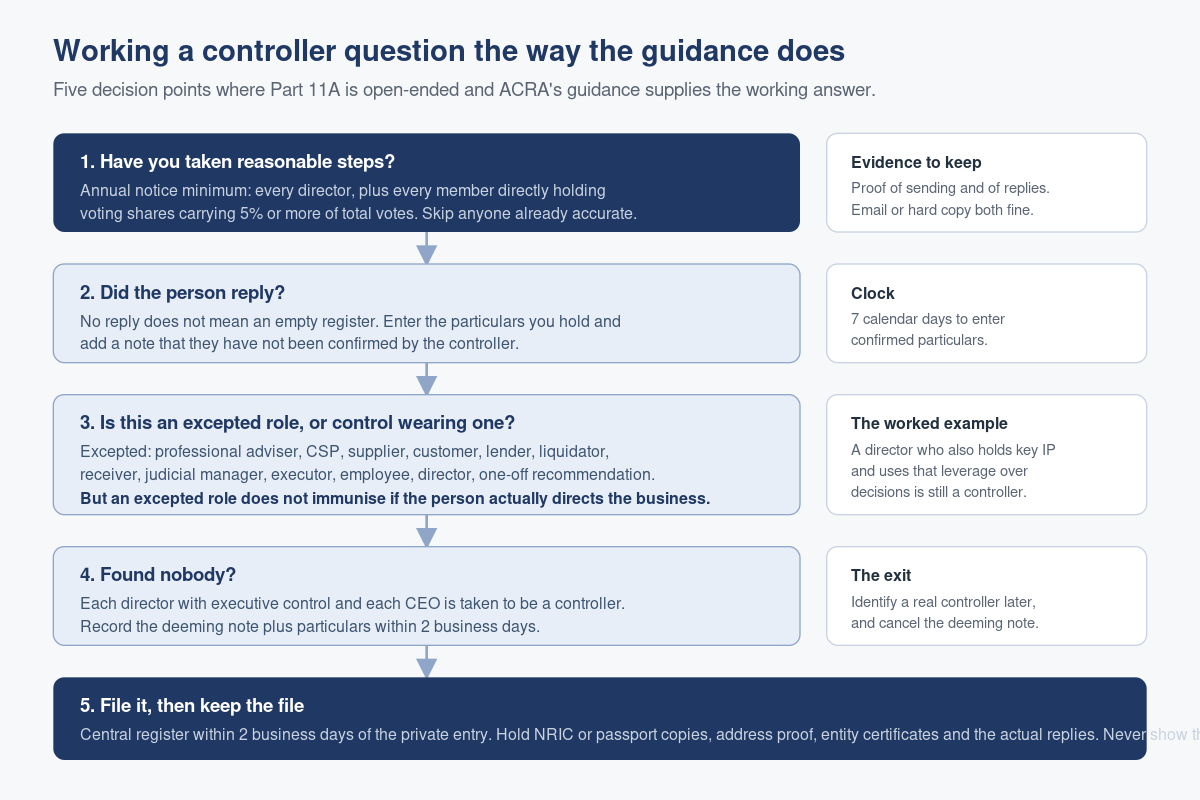
The guidance sets an annual minimum. A company must at least send a notice, once a year, to each of the following:
- Each director of the company.
- Each member of the company who directly holds one or more voting shares, where the total votes attached to those shares are not less than 5 per cent of the total votes attached to all the voting shares in the company.
That is the floor, not the ceiling. If your facts suggest somebody else knows who the controllers are, you send to them too. The guidance also carves out the obvious waste of paper: if a registrable controller, or someone who knows the identity of one, has already given the company accurate information, no notice need go to that person.
Two practical notes that resolve a surprising number of arguments. The notice may be sent electronically or in hard copy, with no requirement to use registered post, and it need not be signed by a director or the secretary. What the guidance does press on is record-keeping: document both the sending of notices and the receipt of replies. Which of the five prescribed notices to use is covered in our note on the five RORC notices.
Hard case two: the controller who does not reply
You sent the notice. Nothing came back. You know who the person is, but you have no confirmed particulars.
Silence does not entitle you to leave the register blank. Enter the particulars you hold, and add a note recording that they have not been confirmed by the registrable controller. That position has been in the guidance since April 2017 and is one of the most commonly ignored paragraphs in it. An empty register invites the conclusion that you did nothing; a populated register with an honest note records what you did and where it stopped.
Hard case three: significant influence or control, and the excepted roles
This is where most genuine analysis happens, because the significant-interest test is arithmetic and the significant-control test is judgement.
The guidance offers a workable shorthand. Being able to direct the activities of a company indicates significant control. Being able to ensure that a company generally adopts the activities you want indicates significant influence. The person need not be seeking economic benefit for either test to be met.
It then lists excepted roles, relationships that do not by themselves make someone a controller:
- Advice or direction in a professional capacity: lawyer, accountant, registered corporate service provider, management consultant, investment manager, tax adviser or financial adviser.
- Dealing with the company under a third party commercial or financial agreement: supplier, customer or lender.
- Exercising a function under a law: administrator or executor of an estate, regulator, liquidator, receiver or manager, judicial manager.
- An employee acting in the course of employment, or a director of the company.
- A one-off recommendation to members on an issue subject to a member vote.
The sentence that stops the excepted roles being a loophole
The guidance then closes the door it just opened. A person performing an excepted role may still be a controller because of surrounding circumstances. The worked illustration: a director who also owns assets or holds relationships critical to the business, such as key intellectual property, and who uses that leverage to influence important decisions, cannot rely on the excepted role of “director”.
The same logic applies to your own firm. Being a registered corporate service provider is an excepted role, but if your people are in fact directing the business rather than administering it, the exception will not save the analysis. See shadow director liability, and registrable controllers in practice plus who counts as a registrable controller for worked structures.
Hard case four: no controller can be identified
If, having taken the reasonable steps, the company knows or has reasonable grounds to believe it has no registrable controller, or has one but cannot identify them, each director with executive control and each chief executive officer is taken to be a registrable controller.
The register must then carry a note stating which of the two situations applies, and stating that each director with executive control and each CEO is taken to be a registrable controller. Their particulars go in alongside it, within two business days of the date the company reaches that conclusion. The notice cycle does not apply to these deemed entries.
There is an exit. If the company later identifies a registrable controller and enters their particulars, it must at the same time enter a further note recording that the directors with executive control and CEOs are no longer taken to be registrable controllers, and the date the real controller’s particulars went in.
Hard case five: an exempt entity sitting in your ownership chain
Until 2026 this was a genuine argument. A subsidiary would send a controller notice up to a listed parent or a regulated entity, and get back a reply to the effect that the recipient was exempt from Part 11A and owed nothing.
Section 96 of the Corporate and Accounting Laws (Amendment) Act 2025, which commenced on 6 May 2026, inserted a new subsection (1A) into section 386AA of the Companies Act 1967. Sections 386AG(6), 386AH(6), 386AI(6), 386AIA(3), 386AJ and 386AK now apply to a person who is, or who there are reasonable grounds to believe is, a registrable controller of a non-exempt company or foreign company, whether or not that person is itself listed in the Fourteenth or Fifteenth Schedule. Exemption from keeping your own register was never exemption from answering somebody else’s notice, and the statute now says so. See what the Amendment Act changed for CSPs and nominee directors.
The timings the guidance pins down
| Step | Period |
|---|---|
| Enter or update confirmed particulars in the private RORC | Within 7 calendar days after the particulars are confirmed |
| Enter the deeming note and particulars where no controller is identified | Within 2 business days |
| File updates with the central register of controllers | Within 2 business days after entering or updating the private register |
| Companies incorporated on or after 16 June 2025: file controller information | At the time of incorporation |
| Enter information received from a nominee director into the ROND | Within 7 days after receiving it |
The move from two business days to seven calendar days for entering confirmed particulars into the private controller register came in with version 2.0 on 16 June 2025. If your internal procedure still says two business days for that step, it is out of date, although being early is not an offence. The two-business-day figure for lodging with the central register did not change. The two clocks run consecutively, not in parallel, and the second is the one people miss. See filing your RORC with ACRA and filing your ROND and RONS with ACRA’s central registers.
What goes wrong in practice
Treating the register as the whole file. Agencies may ask for supporting documents, and the guidance gives examples: an NRIC copy for a citizen or permanent resident controller; a passport plus address verification such as a utility bill for a foreign individual; a certificate of registration and address verification for a foreign legal entity not registered here; and the replies or correspondence that caused the particulars to be entered. A register with no evidence behind it is one nobody can stand up.
Showing the register to the wrong person. The controller register must not be disclosed or made available for inspection to any member of the public, and auditors are not entitled to access it either. If a member of the company asks to see it, the company must decline. It must, however, be produced to the Registrar and ACRA officers, and to public agencies such as the Singapore Police Force, the Commercial Affairs Department, the Corrupt Practices Investigation Bureau and IRAS.
Documenting nothing when you decide no notice is needed. The guidance permits you not to send an update notice where you know for a fact that nothing has changed, and advises you to document why. A decision not to act still needs a file note. Relatedly, where a registered filing agent keeping the register resigns, the agent should hand it to the company, which may then appoint another. Put that in your offboarding checklist.
Confusing the three registers. The guidance has said since July 2017 that the controller register and the nominee director register are different registers with different definitions, and the point was extended to nominee shareholders in October 2022. A person can be on one, two, all three or none. See the register of nominee directors and who counts as a nominee shareholder.
Frequently asked questions
Is ACRA’s RORC guidance legally binding?
No. ACRA states that the guidance is not exhaustive and does not constitute legal advice. It is the Registrar’s published interpretation of Part 11A of the Companies Act 1967 and the 2017 Regulations. It is not a defence in itself, but it is the standard an inspecting officer will apply, so departing from it needs a documented reason.
What is the minimum a company must do to satisfy “reasonable steps”?
Send a notice at least once a year to every director, and to every member who directly holds voting shares carrying not less than 5 per cent of the total votes in the company. You may skip a person who has already given you accurate information. That is a floor, not a complete answer, and more may be required on your facts.
What do I put in the register if a controller ignores my notice?
Enter the particulars you already hold, together with a note recording that they have not been confirmed by the registrable controller. Do not leave the register empty. Keep the evidence that the notice was sent, because an unanswered notice plus a dated record is a far better position than a blank page.
Can our auditor see the register of registrable controllers?
No. The guidance states that auditors are not entitled to access the register, and that it must not be disclosed or made available for inspection to any member of the public. Access is for the Registrar, ACRA officers, and public agencies such as the police, the Commercial Affairs Department, the Corrupt Practices Investigation Bureau and IRAS.
How long do we have to update the register and then file it?
Confirmed particulars go into the private register within seven calendar days of confirmation. The filing with ACRA’s central register is due within two business days after you enter or update the private register. Companies incorporated on or after 16 June 2025 file their controller information at the point of incorporation.
Reading the guidance the way an inspector does
Start with the version change log, because it tells you what the Registrar has seen go wrong. Read the paragraph that matches your fact pattern. Then write down why your answer is what it is, and put that note in the file next to the register. That last step is the difference between a register that survives an inspection and one that does not.
Raffles Corporate Services maintains controller and nominee registers for several hundred Singapore companies and branches, runs the annual notice cycle, and keeps the evidence file. The guidance documents sit on ACRA’s website, and Part 11A of the Companies Act 1967 on Singapore Statutes Online.
— The Editorial Team, Raffles Corporate Services
Need help with corporate secretarial or compliance matters?
If you would like help with your company's corporate secretarial, governance or compliance requirements, email [email protected] or WhatsApp +65 8501 7133.
Our team can assist with corporate secretarial, accounting and tax matters. Where legal advice is needed, advisers from our associated law firms can assist.