

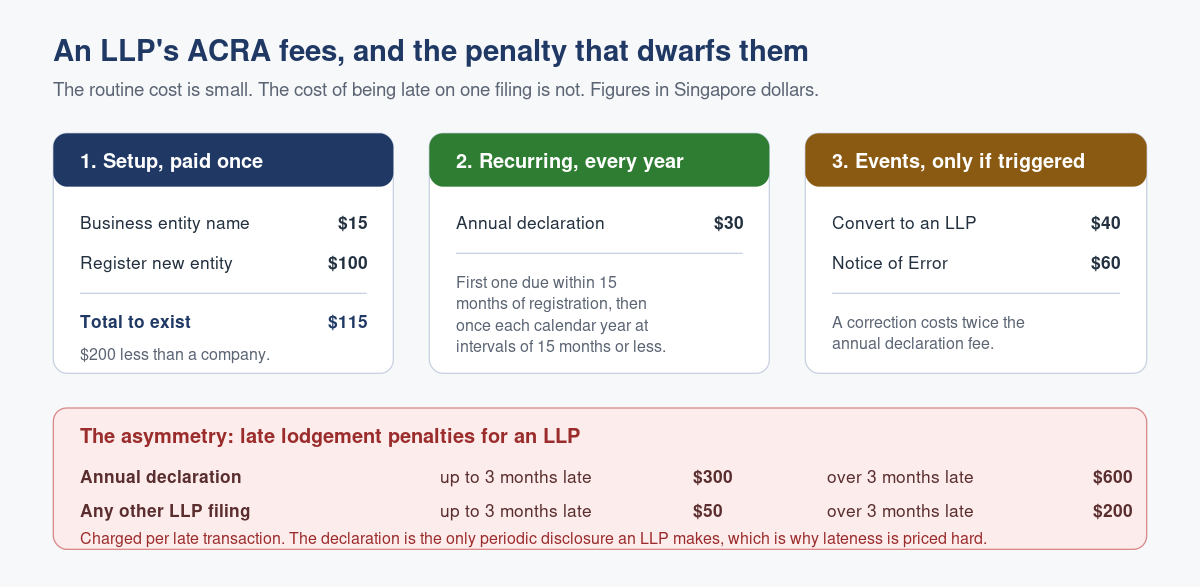
A Singapore limited liability partnership costs $115 in ACRA fees to register: $15 for the business name application and $100 for the registration itself. After that the recurring government charge is $30 a year for the annual declaration. That is the entire routine cost.
Raffles Corporate Services works with a panel of experienced Singapore law firms who offer cost-effective and efficient legal service and advice. This article is general information only and is not legal advice.
An LLP is therefore the cheapest way in Singapore to obtain a separate legal entity with limited liability. It costs $200 less to register than a private limited company and its annual filing fee is half the company annual return fee.
The catch sits in the penalty schedule, where a late annual declaration is priced at several multiples of the declaration itself. That asymmetry is the most important thing about running an LLP, and the rest of this piece explains it.
How the LLP schedule is structured
Three groups, and knowing which group a charge sits in tells you whether it is avoidable.
Setup, paid once. A name application and the registration. You cannot register without an approved name, so treat both as one $115 bill.
Recurring, paid annually. The annual declaration. This is the LLP’s equivalent of a company’s annual return: a periodic confirmation to the Registrar that the entity is still there and still solvent. Not optional, not turnover-dependent.
Events, paid only if triggered. Converting an existing business or firm into an LLP, and correcting a filing that went in wrong.
If the numbers change at the next revision, the structure will not. An entity with perpetual existence and limited liability will always carry a periodic confirmation filing, and that will always be the deadline that matters.
What it costs to register an LLP
| eService | Fee |
|---|---|
| Apply for a new business entity name | $15 |
| Register a new business entity | $100 |
| Total to come into existence | $115 |
The name application is where people waste money. It is chargeable per attempt and not refunded when the name fails, and LLP names fail for the usual reasons: identical to something already registered, considered undesirable, or containing a word that must be referred to another authority first. Check before you pay.
$115 is the complete government charge. Anything above it is professional fees, a registered office address, or an ongoing service. Insist on seeing the split.
Where an LLP sits between the other structures
| Sole proprietorship or partnership | LLP | Private limited company | |
|---|---|---|---|
| Total ACRA fees at setup | $115 | $115 | $315 |
| Recurring ACRA filing | Renewal fee of $30 each term | Annual declaration, $30 a year | Annual return each year |
| Separate legal personality | No | Yes | Yes |
| Partner or owner liability | Unlimited, personal | Limited, subject to a partner’s own wrongful acts | Limited to shares taken |
| Audited accounts required | No | No | Only if not exempt |
| Financial statements filed publicly | No | No | Yes, subject to exemptions |
The interesting cell is the fee row. An LLP costs the same as a sole proprietorship to register and gives you what the sole proprietorship cannot: a body corporate that exists separately from its owners, so an ordinary business debt is the LLP’s debt and not yours.
Our companion pieces cover the other two columns: ACRA fees for a sole proprietorship or partnership and ACRA service and transaction fees for companies.
The annual declaration: $30, and the whole ball game
| eService | Fee |
|---|---|
| File annual declaration | $30 |
Every LLP must file an annual declaration with ACRA. The manager makes it, and it states whether the LLP is or is not able to pay its debts as they fall due. Under the Limited Liability Partnerships Act 2005 the first declaration is due within 15 months of registration, and thereafter once in every calendar year at intervals of no more than 15 months.
Read that timing rule carefully, because it contains two separate constraints and people satisfy one while breaching the other. You need a declaration in each calendar year, and no more than 15 months may elapse between declarations. An LLP that files in January one year and December the next has a gap of 23 months and has breached the interval rule even though it filed in both calendar years.
$30 is the fee. It is trivial. The obligation behind it is not, because the declaration is a solvency statement made by a named individual, and the manager’s exposure sits behind it.
Why the penalty dwarfs the fee
This is where the LLP schedule diverges sharply from every other structure. ACRA’s late lodgement penalties are tiered by how long the default has run, and for LLPs the annual declaration has its own, much higher tier.
| Filing | Late by up to three months | Late by more than three months |
|---|---|---|
| LLP annual declaration | $300 | $600 |
| Any other LLP filing | $50 | $200 |
| Company filing (other than annual return) | $50 | $200 |
The annual declaration penalty is ten times the filing fee if you are a day late, and twenty times if the default runs past three months. No other routine ACRA filing carries that ratio.
The reason is not arbitrary. An LLP publishes almost nothing. It does not lodge financial statements the way a company does, so the annual declaration is the only periodic signal the Registrar and the public get about whether the entity is solvent. Pricing lateness aggressively is how the regime protects the value of the one disclosure it has. Seen that way, the number is less a fine than the cost of the privilege of not filing accounts.
The full tier structure across every entity type is set out in our guide to ACRA late lodgement penalties.
The event fees
| eService | Fee |
|---|---|
| Convert to an LLP, via general lodgement | $40 |
| File a Notice of Error, via general lodgement | $60 |
Conversion, $40. The route in from an existing general partnership or firm. $40 to move a group of partners from unlimited personal liability into a body corporate is the best-value filing on any ACRA schedule. What changes is the compliance cycle: the new LLP acquires the annual declaration obligation and its manager acquires the duties that go with it. Budget for the cycle, not the conversion.
Notice of Error, $60. The formal mechanism for correcting information already on the register. It costs twice the annual declaration, which tells you what ACRA thinks of avoidable corrections. Until it is processed, the register shows the wrong particulars.
What the fee page leaves out
Late lodgement penalties on everything else. Changes to the registered office address and changes of managers must be filed within 14 days. Penalties are charged per late transaction, so two manager changes filed four months late are two penalties, not one.
Offences, not just penalties. Persistent failure to file an annual declaration is not a billing matter. The manager is exposed, and enforcement can escalate beyond a penalty payment.
Closing the LLP. An LLP that has stopped trading still owes annual declarations until it is properly wound up or struck off. Dormancy is not an exemption. We cover the routes out in closing an LLP and, specifically, striking off an LLP.
Information products. Profiles, extracts and certified copies are priced separately. See types of ACRA information products.
Where the money actually leaks
Forgetting the annual declaration in year one. The first deadline is 15 months after registration, not 12, which means it falls at an odd time that matches nothing else in the business calendar. This is the most commonly missed LLP deadline we see.
Satisfying the calendar year rule but breaching the 15-month interval. Filing in January then the following December looks compliant and is not.
Assuming a dormant LLP has nothing to file. It does. The declaration is about solvency and existence, not about activity.
Letting manager changes drift. $50 becomes $200 at the three-month mark, per change.
Choosing an LLP for the fee saving and then ignoring the obligation. $115 and $30 a year is cheap. $600 a year in penalties is not, and it is entirely self-inflicted.
Frequently asked questions
How much does it cost to register an LLP in Singapore?
$115 in ACRA fees: $15 for the business entity name application and $100 to register the entity. That is the complete government charge, and it is $200 less than registering a private limited company. Anything above $115 in a quotation is professional or service fees and should be itemised separately.
How much is the LLP annual declaration fee?
$30 per filing. It is the only recurring ACRA charge an ordinary LLP pays. The fee does not include any professional work needed to satisfy yourself that the solvency statement is accurate, and it does not protect you from a late lodgement penalty if the declaration goes in after its due date.
When is an LLP annual declaration due?
The first is due within 15 months of registration. After that, one declaration must be filed in each calendar year, and no more than 15 months may pass between consecutive declarations. Both limbs must be satisfied, so filing early one year and late the next can breach the interval rule even if every calendar year has a filing.
What is the penalty for a late LLP annual declaration?
$300 if the declaration is filed up to three months after its due date, and $600 if the default runs longer than three months. That is ten to twenty times the $30 filing fee, which reflects the fact that the declaration is the main periodic disclosure an LLP makes. Bizfile displays the exact amount payable when you file.
Is an LLP cheaper to run than a private limited company?
On ACRA fees alone, yes: $115 to register against $315, and $30 a year against the company annual return fee. An LLP also does not lodge financial statements. The trade-offs are different tax treatment, a different liability profile for partners, and a much harsher penalty for a late annual declaration, so the cheaper structure is not automatically the right one.
Do these LLP fees and penalties change?
Yes. ACRA revises both schedules from time to time and each page carries a last-updated date. Before budgeting or quoting, open ACRA’s own fee page and its late lodgement penalties page and read the current figures. Treat every secondary source, including this article, as needing that check.
Making the cheap structure stay cheap
An LLP is excellent value. $115 for a separate legal entity with limited liability, and $30 a year to keep it in good standing, is as inexpensive as corporate compliance gets in Singapore.
It stops being inexpensive in one way: the annual declaration slips. And it slips for a structural reason rather than a careless one, because the 15-month rhythm does not line up with anything else the business does. Nobody forgets a deadline that arrives every 31 December.
Raffles Corporate Services runs the compliance calendar for LLPs as well as companies, tracks the interval rule as well as the calendar year rule, and files manager and address changes inside the 14-day window. If you are not certain when your LLP’s next annual declaration falls due, that is a short check and a cheap one.
More on Singapore corporate secretarial practice at Singapore Secretary Services. ACRA’s current LLP fee page is at acra.gov.sg, and the Limited Liability Partnerships Act 2005 is on sso.agc.gov.sg.
— The Editorial Team, Raffles Corporate Services
Need help with corporate secretarial or compliance matters?
If you would like help with your company's corporate secretarial, governance or compliance requirements, email [email protected] or WhatsApp +65 8501 7133.
Our team can assist with corporate secretarial, accounting and tax matters. Where legal advice is needed, advisers from our associated law firms can assist.